The $625 ACS skills assessment fee is non-refundable. Applicants who pay it on the wrong pathway discover that fact after the outcome letter arrives, not before. The Australian Computer Society (ACS) does not offer RPL as a preference alongside the qualifications route. It directs you there when your qualifications fail to clear its recognition thresholds, and that single mechanic is what most migration research gets backwards.
This guide helps you self-diagnose which pathway your background actually lands in before you pay. It assumes you are an ICT professional applying for a skilled visa (subclass 189, 190, 491, or 186) and trying to establish whether Recognition of Prior Learning is your only route to an ACS skills assessment.
What the ACS RPL pathway covers, and where it stops
RPL assesses competency built through work, not through study. No tertiary qualification is assessed at all on this route. ACS reads your practical knowledge and your demonstrated technical contribution, then decides whether that evidence maps to your nominated occupation at the required skill level. Hold a degree ACS recognizes, and you never touch this route.
That boundary matters because the route is deliberately narrow. It exists for one purpose: to give ICT professionals whose formal education ACS cannot recognize a way to prove competence through work evidence instead.
How RPL differs from the qualifications pathway
The qualifications pathway (ACS calls the main version General Skills) starts from your degree and checks whether its content and level satisfy the occupation you nominate. RPL starts from the opposite end. No qualification to check means ACS reads your work history and two project reports instead. The ACS pathways comparison and pathways explained guides cover the full menu. The point here is narrower: you do not pick between pathways. The state of your qualification picks for you.
ACS RPL is not CDR, and the difference matters
Overseas applicants researching migration hit two acronyms that look interchangeable and are not. A CDR, the Competency Demonstration Report, is Engineers Australia's assessment instrument for engineering occupations. ACS RPL is the computing equivalent, run by a different assessing body for ICT ANZSCO codes. When your occupation sits under ICT, say 261313 Software Engineer, Engineers Australia does not assess you, and a CDR is the wrong document entirely. Confusing the two costs weeks and, again, a non-refundable fee.
Three backgrounds that get directed into RPL
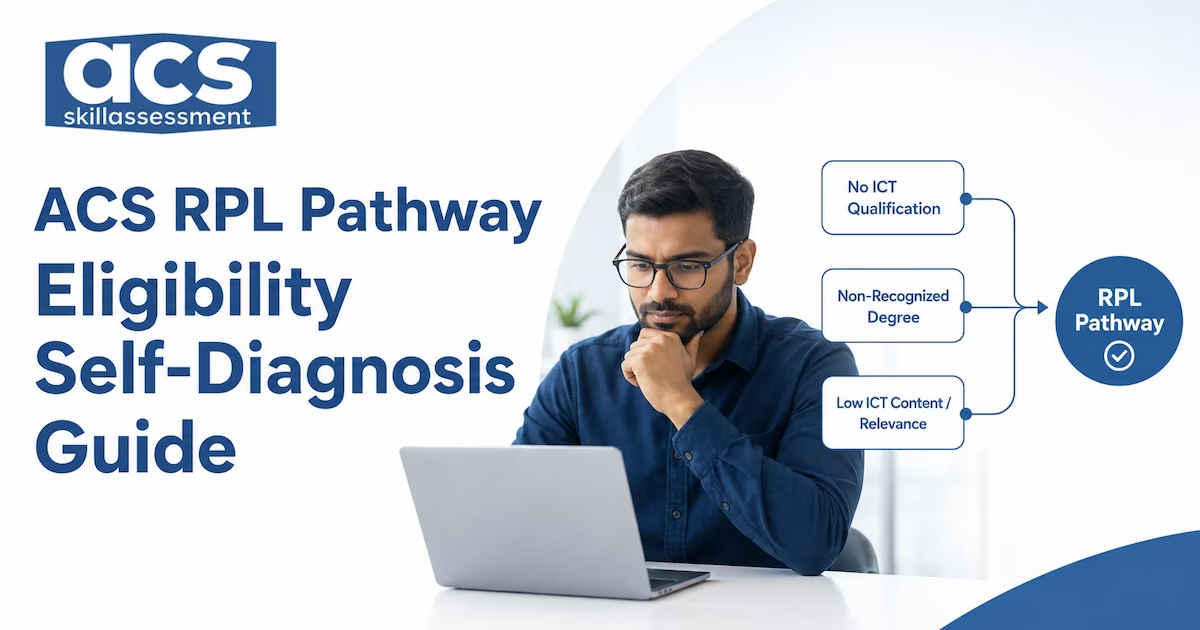
Three specific profiles trigger the RPL route. Read each against your own transcript and work history.
No formal ICT qualification anywhere on your transcript
Self-taught developers, bootcamp graduates, and career changers who moved into ICT without a computing degree have no qualification for ACS to assess. RPL is the only door open. Your competence is real; it just lives in your work history rather than a transcript, and ACS will ask you to prove it through employment evidence and project reports rather than course credits.
An ICT degree from an institution ACS does not recognize
Recognition has nothing to do with academic quality. The question is simply whether ACS lists your institution and qualification as meeting its criteria. A degree from a university that tops its national rankings but sits outside ACS recognition routes you to RPL exactly as if you held no degree at all.
A non-ICT degree carrying real ICT work
A commerce, mechanical engineering, or mathematics degree does not carry enough ICT content to satisfy the qualifications pathway, even when the holder has spent years working as a systems engineer. The thresholds are concrete, and the exact numbers appear in the section below. For this profile, years in the field become the asset, and RPL is how you present them.
What an RPL application actually asks you to submit
The submission has three moving parts, each with its own failure mode.
Work experience thresholds and the reference letter bar
The ACS RPL pathway page sets a minimum of six years of relevant work experience, with your most recent role active or completed within the last two years. ACS publishes experience thresholds per ANZSCO occupation code, so the minimum for your specific code may differ; verify the requirement for your nominated code before you assume the six-year baseline applies. Employment counts only if it runs at least 20 hours per week; anything below that is assessed as unsuitable. Each role you claim needs a reference letter on company letterhead stating your dates, hours, title, and actual duties, because ACS matches those duties against your nominated ANZSCO code.
One cost is easy to miss. Years spent qualifying for RPL do not count as Skilled Employment for migration points. ACS sets a Skill Level Requirement Met Date, and only experience after that date accrues as skilled. When your total experience sits near the six-year floor, this can erase points you assumed you already had.
Two project reports, and what each has to prove
RPL requires two project reports, and many online migration guides are wrong on the timeframes in ways that matter. The ACS RPL pathway page specifies one project completed within the last two years and one within the last four years. Many service blogs cite three and five years. Those figures are incorrect; following them will have you describing projects outside the accepted window.
Each report must document your specific technical contribution: decisions you made, problems you solved, outcomes you owned. A company overview or a project summary that never isolates your role fails. Write in the first person about what you built, not what the team delivered. ACS runs originality checks, so reused or templated reports are a common rejection trigger; the plagiarism-avoidance guide covers that failure mode in detail.
Vendor certifications are a narrow exception. ACS accepts them as evidence of current skills only for the DevOps and Cyber Security ANZSCO codes. Nominate any other occupation and plan to rely on a CCIE or AWS certificate in place of a project report, and the application will not comply.
Identity documents, the fee, and the online form
The rest is procedural: certified identity documents, at least two forms of evidence showing current skill in your nominated code, and the online application form. The fee is $625 and non-refundable whatever the outcome, which is why screening your eligibility before you pay is where the most effort should go. The document checklist and 2026 fee guide cover paperwork and payment specifics. Standard processing runs four to six weeks when no additional documents are requested.
How to confirm which pathway your background fits
Match your occupation to its ANZSCO code first
ACS assesses you against one ANZSCO code, not against ICT in general. 261111 ICT Business Analyst, 263111 Computer Network and Systems Engineer, and 261313 Software Engineer are three of the most common codes, and they demand different evidence. Pick the code that matches the work you can actually document, then check its skill level requirement. Qualification relevance, experience thresholds, and the entire assessment are all judged against that single code.
The two-stage content gate that reroutes partial-ICT degrees
For degree holders, two gates decide whether you stay on the qualifications pathway or drop into RPL. The first is raw ICT content. Per the ACS qualifications evidence page, a Bachelor's degree needs at least 33% ICT content to count as an ICT Major, a two-year postgraduate needs 50%, and a postgraduate built on 12 subjects needs 67%. Clear that threshold, and a second gate opens: at least 65% of your degree's ICT content must be closely related to your nominated occupation. This is where cross-discipline applicants get caught. A software-heavy degree can clear 33% comfortably and still fail the 65% relevance test when nominated against a networking code like 263111, routing an otherwise qualified graduate into RPL.
The checklist below is built from the public ACS criteria above. Answer in order and stop at the first Yes.
1. No formal ICT qualification? If yes, RPL is your pathway.
2. ICT degree from an institution not on the ACS recognized list, and not covered by a Seoul Accord notification? If yes, RPL.
3. Non-ICT degree, or below the ICT-content threshold (33% Bachelor, 50% two-year postgraduate, 67% for a 12-subject postgraduate)? If yes, RPL.
4. Degree clears those thresholds and aligns at least 65% with your nominated ANZSCO occupation? If yes, you likely qualify for the qualifications pathway, not RPL.
A Yes to any of the first three means budget for RPL and stop assuming the qualifications route is available.
What ACS weighs when an assessor reads your submission
Contribution depth beats job title and tenure
A senior title and a decade of service do not carry an RPL submission. Assessors read for evidence that you personally performed work at the level your occupation demands. "The team migrated the data center" tells ACS nothing about you. Detailing the cutover sequence you designed, the rollback trigger you set, and the reasoning behind each decision demonstrates competence. Concrete technical decisions are the currency; years and titles are context, not proof.
What your ANZSCO skill level signals about expected depth
Most professional ICT codes sit at skill level 1, the tier normally associated with a bachelor degree or higher. That classification does not create a separate RPL checklist, but it does set the assessor's expectation of complexity. At skill level 1, project evidence should show design and decision-making commensurate with degree-level work, not routine task execution. A visible gap between the sophistication of your reported work and the occupation you claim is something an experienced assessor will notice.
The overseas-degree trap that pays the fee twice
A famous university is not an ACS-recognized one
The most expensive assumption in ICT migration is that a well-known university guarantees the qualifications pathway. ACS recognition is a specific listing decision, independent of global reputation or local prestige. Graduates from strong overseas programs routinely assume they qualify, apply via the qualifications pathway, and get redirected into RPL anyway. Verify before you assume, not after you have paid.
Reading the recognized list and the Seoul Accord step
Two checks settle the question. First, confirm your qualification and institution against the ACS recognized qualifications list; that list, not your degree certificate, is the gate. Second, if your program is accredited under the Seoul Accord, recognition is possible but not automatic. ACS states such qualifications "may be considered" to meet the ICT major criteria, and the onus is on you to notify ACS and supply supporting evidence from the Seoul Accord website. Applicants who treat the accreditation as self-applying often submit without that evidence and lose the recognition they were entitled to. When neither check lands in your favor, the RPL pathway is where you belong, and confirming that early costs far less than discovering it after payment.
Before you commit either way, it helps to see where RPL applications actually fail. Read the ACS RPL rejection reasons guide to see the specific gaps that get submissions refused before an assessor even scores your project reports.
FAQs: who needs the ACS RPL pathway
Can I use RPL if ACS does not recognize my overseas ICT degree?
Yes. When your ICT degree is not on the ACS recognized qualifications list, RPL becomes your route regardless of the university's local standing, whether that institution is in India, the Philippines, or anywhere else ACS does not list. Check your institution against that list first. If your program carries Seoul Accord accreditation, notify ACS with supporting evidence rather than assuming recognition is applied automatically.
Does work experience alone qualify me for RPL?
Yes, experience alone can qualify you. RPL exists precisely for applicants without a recognized qualification. You need at least six years of relevant work plus two compliant project reports; the work must run at 20 or more hours per week and map to your nominated ANZSCO code. No degree is required, though you should verify the exact threshold for your specific occupation code on the ACS website.
Does a partially ICT-related degree route me into RPL?
Not automatically. The outcome depends on two thresholds. A Bachelor's degree carrying less than 33% ICT content fails the first gate. A degree that clears 33% but where less than 65% of that ICT content aligns with your nominated occupation fails the second. Either failure routes you to RPL even if your overall degree is in a technical field.
How many years of experience does ACS RPL require?
The ACS RPL pathway page states a minimum of six years of relevant work experience, with the most recent activity within the last two years. ACS publishes thresholds per occupation code, so confirm the requirement for your specific ANZSCO code rather than assuming the six-year baseline always applies. Note also that years used to qualify for RPL do not count as Skilled Employment for migration points; only experience after your Skill Level Requirement Met Date does.
Can I reapply via RPL after a qualifications refusal?
Yes, a fresh RPL application can be lodged, but it carries a new $625 fee. Before resubmitting, establish why the first attempt failed. The same evidence gaps often follow an applicant across both pathways, and paying twice without addressing the underlying deficiencies produces the same result.