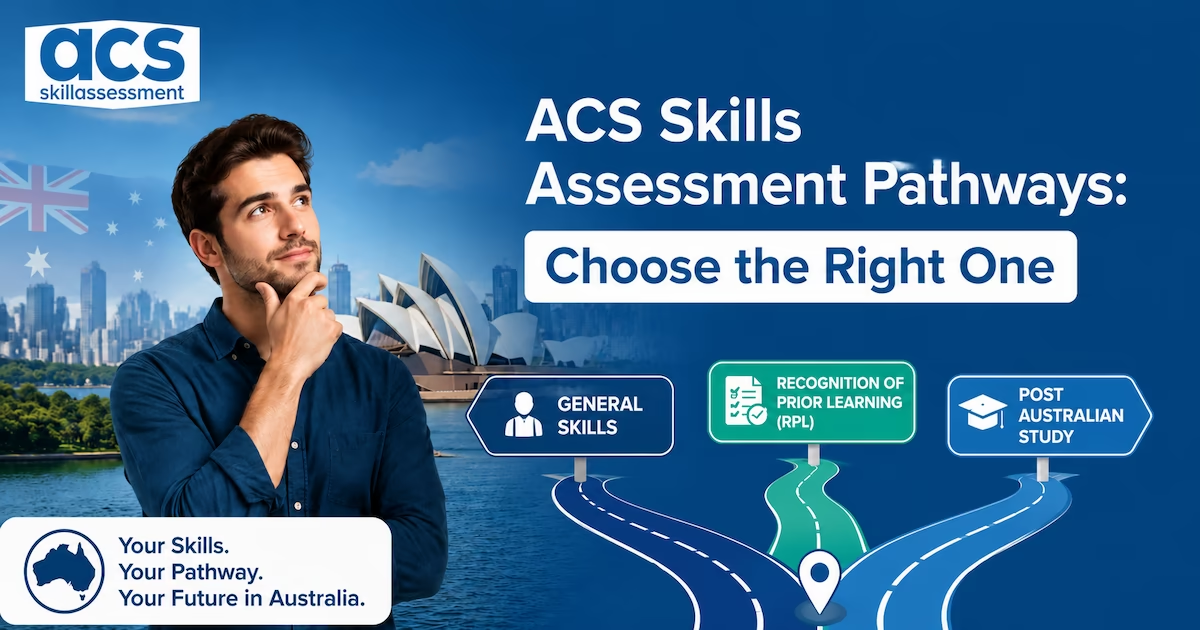
The three main ACS skills assessment pathways end at the same destination: one outcome letter, valid for two years, accepted across the same skilled migration visa subclasses. What separates them is the road in. General Skills costs $1,498. RPL costs $625 but asks you to write two project reports from scratch. Post Australian Study sits at $1,136 and opens only to a narrow group. Pick the wrong pathway and you can lose a month or more re-lodging under the one you should have chosen first.
This guide sorts you into the right one from three inputs: your qualification type, the country you studied in, and your years of ICT experience. No agent call required. Skip to the decision rules near the end, or work through each pathway first.
Who picks a pathway, and when the choice locks in
An ACS assessment is the gate for every ICT occupation on Australia's skilled migration lists. If you are applying for a subclass 189 (Skilled Independent), 190 (Skilled Nominated), or 491 (Skilled Work Regional) visa under an ICT ANZSCO code, the Department will not count your points until ACS has assessed you as suitable. It is a prerequisite, not a parallel step you can run later.
The pathway is baked into your application the moment you submit. ACS does not shuffle you between pathways if you choose wrong; it assesses what you lodged against that pathway's rules and returns an outcome. Your ANZSCO occupation code locks at the same point. Since early 2025, you can nominate up to three ANZSCO codes in a single application at one fixed fee, with a separate outcome letter for each, and ACS suggests codes from the skills you enter. Once the application is in, that selection cannot be changed. Choosing the pathway is therefore a pre-lodgement decision, and getting it wrong means a fresh application and a second fee, not a quick correction.
What changes across the three ACS skills assessment pathways
Here is the whole decision on one screen. Every fee and processing figure below comes from the ACS pathway pages at acs.org.au, current at the time of writing.
Pathway | Fits | Core eligibility | Est. documents | Fee | Processing |
|---|---|---|---|---|---|
General Skills | Recognized ICT degree holders with experience | Degree with ICT major: 2 yrs in last 10, or 4 yrs total | 6-8 (identity, qualification, employment refs) | $1,498 | 4-6 weeks |
RPL | Practitioners with no recognized ICT degree | 6 yrs experience, most recent role within 2 yrs | 10-14 (identity, employment refs, 2 project reports, 2+ currency forms) | $625 | 4-6 weeks |
Post Australian Study | Recent Australian ICT graduates | Australian IT/Data Science degree plus 365 days work | 6-8 (identity, qualification, employment refs) | $1,136 | 4-6 weeks |
All three produce an identical outcome, valid for two years from issue. ACS raised these fees by 3.3% on 3 November 2025, so any guide still quoting $530 to $700 for these pathways predates the current schedule. The spread that matters is real: General Skills costs $873 more than RPL and $362 more than Post Australian Study, for the same outcome letter. (A fourth option, Qualification Only at $625, verifies a qualification for the Temporary Graduate 485 visa and Professional Year enrolment. It does not produce a migration outcome for 189, 190, or 491, so it is out of scope here.)
One caution on speed. The pathway pages quote 4-6 weeks, but the main ACS assessment page and the 2025 multi-code update reference longer timelines, up to 8-10 weeks. Plan for the higher end so your result does not land after your visa lodgement window closes. You can check the current position on our ACS processing time guide.
The document counts above illustrate where the real preparation gap lives. General Skills and Post Australian Study ask only for records you already hold or can request: identity, your qualification, and employment references. RPL is a different weight class entirely. Beyond that same evidentiary base, it requires two written project reports and at least two professional currency forms, making it a writing project of several weeks before you can even lodge, not merely a paperwork task.
General Skills Assessment: built for recognized ICT degree holders
General Skills is the default for anyone holding a qualification ACS recognizes as ICT. What ACS checks first is not your experience but your degree's ICT content, because that determines the experience threshold you must then clear:
Bachelor's or higher with an ICT major closely related to your nominated occupation: 2 years of relevant experience in the last 10 years, or 4 years at any time.
Bachelor's or higher with an ICT minor: 5 years in the last 10, or 6 years total.
Diploma or advanced diploma with an ICT major: 5 years in the last 10, or 6 years total.
Only employment of at least 20 hours per week counts toward any of those thresholds. Part-time work below that line is assessed as unsuitable regardless of how many calendar years it spans, so a decade of 15-hour-a-week contracting adds nothing to your case. ACS also identifies the date from which your experience reaches skilled level, and it is the work after that date that feeds the Department's points test, so read the outcome letter closely rather than assuming every year counts.
The usual reason a General Skills application fails is the qualification itself: ACS assesses the degree as insufficiently ICT-related and drops it below the major or minor threshold, which resets the experience requirement or sinks the application entirely. If your degree sits near the line, confirm the ICT content before you pay, not after. See our ACS skills assessment eligibility documents guide for what ACS considers an acceptable qualification record.
RPL: the only route without a recognized ICT degree
RPL exists for one situation: you have the skills but not the paper. No formal qualification, or one ACS judges non-ICT, and RPL is your only door to a migration outcome. Eligibility rests on six years of relevant experience, with your most recent role either currently active or completed within the last two years before you apply.
Part-time experience is pro-rated. Only roles of 20 or more hours per week count at full value; work below that threshold is either disregarded or proportionally reduced depending on hours, meaning ten years of half-time contracting does not give you six qualifying years. Confirm your actual hours before calculating whether you clear the floor.
The project report timing rule is where RPL applicants most often trip. ACS wants two reports: one describing a project completed within the last two years, and a second from within the last four. Your total years of experience do not rescue you here. If your most recent qualifying project is three years old, the application is unsuitable regardless of everything behind it. Check that gate before writing a single word.
Both reports must demonstrate the key knowledge areas of your nominated ANZSCO occupation, applied on real projects, in your own words, with your role and technical decisions spelled out. Two professional currency evidence forms sit on top of that. The dominant rejection cause is exactly what you would expect: reports that stay generic, describe the team's work rather than yours, or read as recycled. If you are close to that line, our RPL rejection self-audit guide walks the common failure patterns. Our RPL plagiarism detection guide covers the originality requirements that catch recycled content.
Post Australian Study: fastest value for recent Australian graduates
Post Australian Study is the cheapest evidentiary pathway, and for the people it fits, the obvious pick. Qualifying requires an Australian bachelor's degree or higher with a major in IT or Data Science closely related to your nominated occupation, plus 365 days of relevant work completed after your degree, at 20 or more hours a week. Completing the ACS Professional Year substitutes for that work requirement entirely.
One myth is worth addressing directly. Competitor blogs repeat a "within two years" recency rule on when you finished your degree, but the acs.org.au Post Australian Study page does not carry that restriction. If a guide tells you your Australian degree has expired for this pathway, verify the source before ruling yourself out. The genuine failure points are narrower: an institution or major that does not qualify, or the 365 days of post-degree work not properly evidenced.
Holders of an Australian ICT degree often qualify for General Skills too. That overlap is where most money gets left on the table, and it is the first rule in the next section.
Picking the right ACS pathway for your background
Start with the rule that saves money. If your Australian ICT degree also meets General Skills recognition, you are double-eligible, and Post Australian Study wins outright. Both pathways run 4-6 weeks, and both ask only for evidentiary documents, but Post Australian Study costs $1,136 against $1,498 for General Skills. Same speed, same outcome, $362 cheaper. When both are open, choose Post Australian Study and move on.
Beyond that, the ACS skills assessment pathways route cleanly by profile:
You hold a recognized ICT degree from any country. General Skills is yours. Confirm your degree clears the major or minor threshold, then check which experience tier applies. If the degree is Australian, apply the double-eligibility rule above first.
You have ICT experience but no recognized degree. RPL, and only RPL. Before anything else, confirm you can point to a qualifying project inside the last two years. Without it, no amount of total experience makes you eligible.
You recently graduated from an Australian ICT program. Post Australian Study, if you have 365 days of post-degree work or a completed Professional Year. If you do not yet meet that requirement, General Skills remains open provided your experience meets a tier.
One principle sits under all three. When you qualify for more than one pathway, let processing speed and document readiness decide, not an assumed eligibility advantage that does not exist. The outcome letter is the same either way. For a full breakdown of what each pathway costs in 2026, see our ACS skills assessment fee guide.
Pathway questions applicants ask before choosing
Can I use RPL if I hold an ICT degree from a non-Australian university?
Only if ACS assesses that degree as non-ICT. RPL is reserved for applicants without a recognized ICT qualification. If your overseas degree meets the ICT major or minor threshold, you belong in General Skills, and lodging RPL instead spends the cheaper-looking fee on a rejection.
What is the processing time gap between General Skills and RPL?
There is none on paper: ACS quotes 4-6 weeks for both on clean applications. The real gap is upstream. RPL's two project reports add weeks of writing before you can even lodge, while General Skills needs only documents you can gather and submit. The clock does not start until you lodge, so RPL's preparation burden is effectively an invisible delay.
Does the Post Australian Study pathway require Australian work experience?
Yes, on the standard route: 365 days of relevant work completed after your degree, at 20 or more hours a week. The one substitute ACS accepts is completion of the ACS Professional Year, which stands in for the work requirement entirely.
Can I switch to a different pathway after an ACS rejection?
Not within the same application. You either appeal (Level 1 within 60 days of the outcome, Level 2 within 30 days of that, each roughly 2-4 weeks to process) or lodge a fresh application under the correct pathway and pay the fee again. Choosing right the first time is the only inexpensive option.
If I qualify for both General Skills and Post Australian Study, which should I pick?
Post Australian Study. Both run 4-6 weeks, and both ask only for evidentiary documents, but Post Australian Study costs $1,136 against $1,498 for General Skills. Same speed, same outcome, $362 cheaper. Cost decides.
Once your pathway is settled, the next mistake to avoid is gathering the wrong paperwork, since each pathway has its own document set and the RPL reports take longer than applicants expect. Confirm you are preparing the right documents before you start: see the complete ACS document checklist for your pathway.