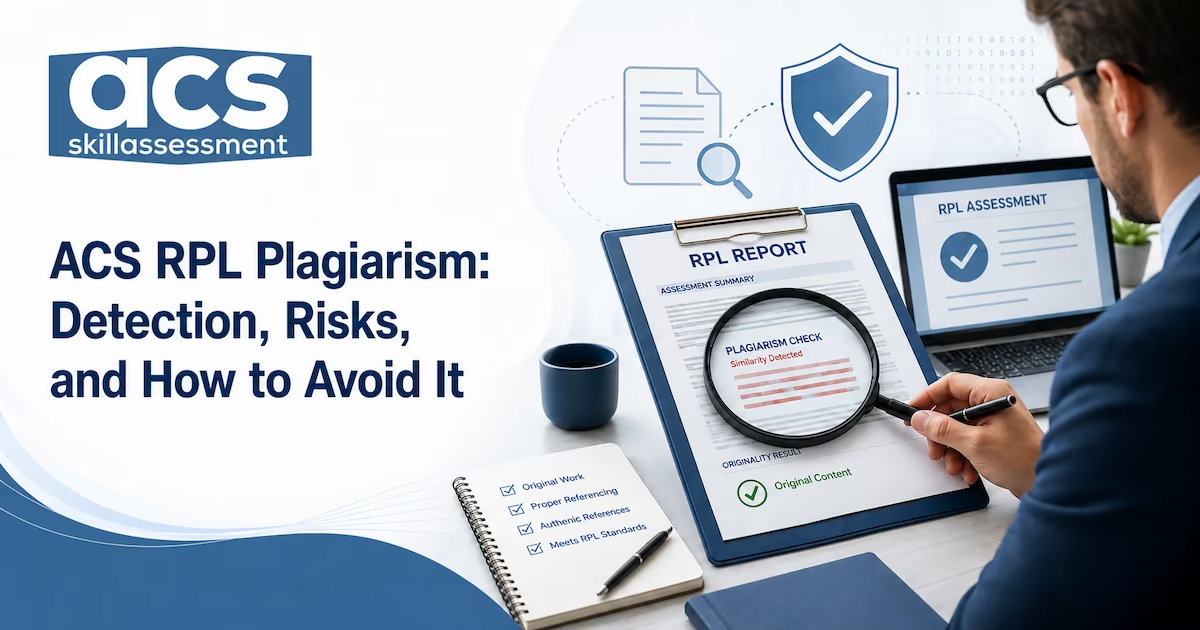
An ACS RPL plagiarism finding is not a warning shot. Under ACS policy, a confirmed breach terminates your application, records the outcome as unsuitable, keeps your assessment fee, and bars you from reapplying while your skilled-migration timeline stalls. Before you write a single sentence of your Recognition of Prior Learning report, know exactly what ACS screens for, what a similarity score does and does not prove, and what actually happens when a submission gets flagged.
What ACS Counts as Plagiarism in an RPL Report
ACS files plagiarism alongside document fraud and misrepresentation of skills as one category of misconduct. Its policy page states it plainly: "Breaches such as document fraud, plagiarism or misrepresentation of skills or knowledge are grounds for termination of an application." In an RPL, that misconduct shows up in three recurring ways.
Copying another applicant's report, even one you found online
Entire RPL reports circulate on forums, in shared drives, and inside the sample libraries of writing services. Lift a project description from one and you have copied another person's claimed experience. ACS holds a database of every RPL it has already received, so a passage borrowed from a report submitted years ago can still match, long after the original page has vanished from the web.
Template and sample text dressed up as your experience
This is the trap most honest applicants fall into. You find a well-structured sample, keep its scaffolding, and swap in your own project names. The connective tissue stays intact: the responsibilities, the methodology sentences, the closing reflections, all identical to thousands of other reports built from the same source. Presenting shared boilerplate as your own documented work is plagiarism whether or not you intended it as fraud.
Resubmitting a rejected RPL without real rewriting
Self-plagiarism is the version almost nobody warns you about. If an earlier RPL was rejected and you resubmit something that closely mirrors it, ACS's internal database matches your new file to your own previous submission. A resubmission that is cosmetically edited but substantively the same as the rejected document can be flagged even when it shows zero matches on any public-web checker.
How ACS Screens Your Report, and Where Turnitin Stops
An ACS RPL plagiarism screen runs on two fronts, and only one of them is visible to you. The ACS InfoHub RPL page states it reserves "the right to use software applications to screen your submitted work for matches either to published sources or to other submitted applications." Read the last clause carefully. One check compares your report to the public and academic web; the other compares it to ACS's own store of previously submitted applications.
No consumer plagiarism tool can reach that second layer. A paragraph can score a clean 0% against the entire indexed web and still match a report ACS already holds. A spotless self-check result reassures you about half the problem and tells you nothing about the other half.
What about Turnitin specifically? It is the industry-standard originality engine and is widely attributed to ACS across migration blogs, but ACS's own accessible policy pages say "software applications," not Turnitin by name. Treat it as a very likely component of the public-source check, not as a confirmed, named part of ACS's process.
Why RPL reports score high even when you wrote every word
Job titles, tool names, framework labels, and the standard shape of a project description are shared across thousands of submissions. Two engineers who both configured Active Directory and wrote Java microservices will produce overlapping sentences without either copying the other. A raw similarity number, on its own, does not tell you whether you have a problem. Context is everything, and the software cannot supply it.
A similarity score is not a plagiarism verdict
This is the factual reason ACS has never published a hard percentage threshold. The software returns a similarity score; a human assessor then reviews what that score has flagged and decides whether it amounts to plagiarism. A high score can survive review if the matches are unavoidable technical terms. A low score can still result in rejection if the assessor sees a lifted block of narrative. Treat any specific figure you see quoted online, such as "under 10%" or "over 20%," as coming from writing-service blogs, not from ACS.
A flagged passage next to a compliant rewrite
To make this concrete, here is a constructed illustration built from the kind of boilerplate that circulates in public sample RPL templates, next to a rewrite of the same underlying work. This is not a real applicant's text; it shows what an assessor is trained to spot.
The flagged version reads like every other report:
> As a Software Engineer, I was responsible for the full software development life cycle, including requirement gathering, design, coding, testing, and deployment, ensuring high-quality deliverables that met organisational objectives and client expectations.
Nothing there is yours. Any assessor has read that exact sentence a hundred times. The compliant version, grounded in a specific job and a specific problem:
> Between 2019 and 2021 I maintained the claims-processing system for a mid-sized insurer. The nightly batch job failed roughly twice a week because of malformed date fields, so I rewrote the validation layer in Java, added a pre-parse check, and cut the failures to near zero over the following quarter.
The second passage cannot match anyone else's report because no one else did that specific work. Verifiable, first-person detail is both the strongest defence against a plagiarism flag and the thing ACS is actually assessing you on.
Whether ACS Cares That Your Copying Was Accidental
At the detection stage, no. ACS policy draws no line between the applicant who deliberately copied and the one who reused a template without understanding the rule. The outcome language, termination, unsuitable, possible ban, sits under the same misconduct clause with no carve-out for good intentions. Boilerplate you genuinely believed was a normal way to structure your report can trigger the same finding as a document copied wholesale.
That is deliberate policy, not an oversight. ACS cannot read motive from a text match, so its rules do not try to. The practical consequence is uncomfortable but clear: "I didn't mean to" is not a defence available after the flag. Your only real protection is writing text that could not match anyone, which brings the burden back to documenting your own work honestly.
The Ban After a Confirmed Finding, and What Else It Costs
A confirmed ACS RPL plagiarism finding does more than reject one report. ACS policy states the outcome "will be recorded as unsuitable, a ban on reapplying may be imposed and the application fee will not be refunded."
Three separate costs, and the middle one deserves a closer look. Notice the word "may." The policy frames the ban as discretionary and states no duration. The widely-repeated 12-month figure comes from ACS Skills Assessment Guidelines documentation, not from that policy sentence. Plan around a 12-month lockout, but understand that the duration, and even the imposition, is an assessor determination, not a switch that flips automatically.
The recorded outcome is the quieter damage. "Unsuitable" is not a neutral "try again." Your fee is gone, and every downstream date slides by the length of the delay: your Expression of Interest, your points-tested visa timeline, your English-test validity. For an applicant timing a submission against age points or a test expiry, a lost year is not an inconvenience. It can move you out of contention entirely.
How to Self-Check Your ACS RPL for Plagiarism Before Submission
Running your own check catches the public-source matches while you can still fix them. Several tools do this well:
Turnitin through an institutional or university account, if you have legitimate access to one.
iThenticate, the professional-grade sibling of Turnitin, aimed at manuscripts and longer reports.
Copyleaks, a paid checker with broad web and academic coverage.
Grammarly Plagiarism Checker, useful as a first-pass scan bundled with its editing tools.
Run your draft, then read what each tool highlights rather than fixating on the total percentage. When a checker flags a passage, do not paraphrase it into a slightly different arrangement of the same claims. Rewrite it from your actual memory of the work: what the system was, what broke, what you changed, what happened next.
One caveat outranks all of this. None of these tools can see ACS's internal database of prior submissions. A clean report from Copyleaks or Turnitin clears the public-source layer and leaves the second layer completely untested. Self-checking is necessary. It is not sufficient.
Reapplying to ACS After a Plagiarism Ban
When the ban period ends, ACS is not waiting for a tidied-up version of the report it already rejected. Because it screens new submissions against its own records, a reapplication that echoes your previous file matches your own prior submission and gets flagged again. Reordered sentences and swapped synonyms both fail this test.
A credible reapplication is a reconstruction. Go section by section and rebuild each project from evidence you can actually produce: employment references, contracts, payslips, and your own recollection of the systems, versions, and outcomes you owned. If a claim in the old report was generic because you had no specific detail to give it, that section most likely triggered the original flag, and it needs the most honest rebuilding now.
This is also where the writing-service question becomes specific. ACS requires you to declare that your reports "are exclusively your own work and have not been outsourced to any third-party service, such as a writing or editing agency." Light proofreading sits in a different category from handing over authorship entirely, but submitting recycled or generic content as your own documented experience contradicts that declaration outright. The two-layer screen is built precisely to catch that.
Questions Applicants Ask Before They Submit
Does ACS use Turnitin to check RPL reports?
Probably, but ACS has not confirmed the name on its accessible policy pages. Those pages say ACS may use "software applications" to screen submissions against published sources and other submitted applications. Turnitin is the industry-standard originality tool and is widely attributed to ACS in migration circles, so treat it as a likely part of the public-source check rather than an officially named one.
What happens if my ACS RPL is found to contain plagiarism?
ACS policy states the application is terminated, the outcome is recorded as unsuitable, a ban on reapplying may be imposed, and the application fee is not refunded. The fee is gone, the result sits on your assessment record, and your migration timeline slips by the length of any ban.
Is there a specific similarity percentage that triggers a plagiarism flag from ACS?
No published threshold exists. The screening software returns a similarity score, and a human assessor decides whether that score reflects genuine plagiarism. Any specific figure you see quoted online comes from writing-service blogs, not from ACS. A high score can pass review; a low one can still result in rejection.
Does ACS treat unintentional plagiarism the same as deliberate copying?
At the detection stage, yes. ACS policy makes no explicit allowance for intent, so template boilerplate reused innocently can trigger the same misconduct finding as deliberate copying. The software cannot read motive from a text match, and the policy does not try to account for it.
Can I use an RPL writing service without it being considered plagiarism by ACS?
Use caution. ACS requires you to declare your reports are exclusively your own work and were not outsourced to any writing or editing agency. Light proofreading differs from handing over authorship, but submitting recycled or generic content as your own documented experience breaches that declaration and is precisely what the screen is designed to catch.
How do I reapply to ACS after a plagiarism-related rejection or ban?
Wait out any ban period, then rebuild the report substantively rather than editing the rejected version. Because ACS screens new submissions against its own prior records, a lightly changed resubmission matches your previous file and gets flagged again. Reconstruct each section from verifiable evidence of your actual work.
Write the report on solid ground from the first draft
The surest defence against a plagiarism flag is a submission built from documented, verifiable experience rather than borrowed structure. Before you write a word, map your report against exactly what ACS expects to see. Our complete ACS skills assessment document checklist walks through every document and declaration your RPL needs, so the report you submit is grounded in your own evidence and nothing else.