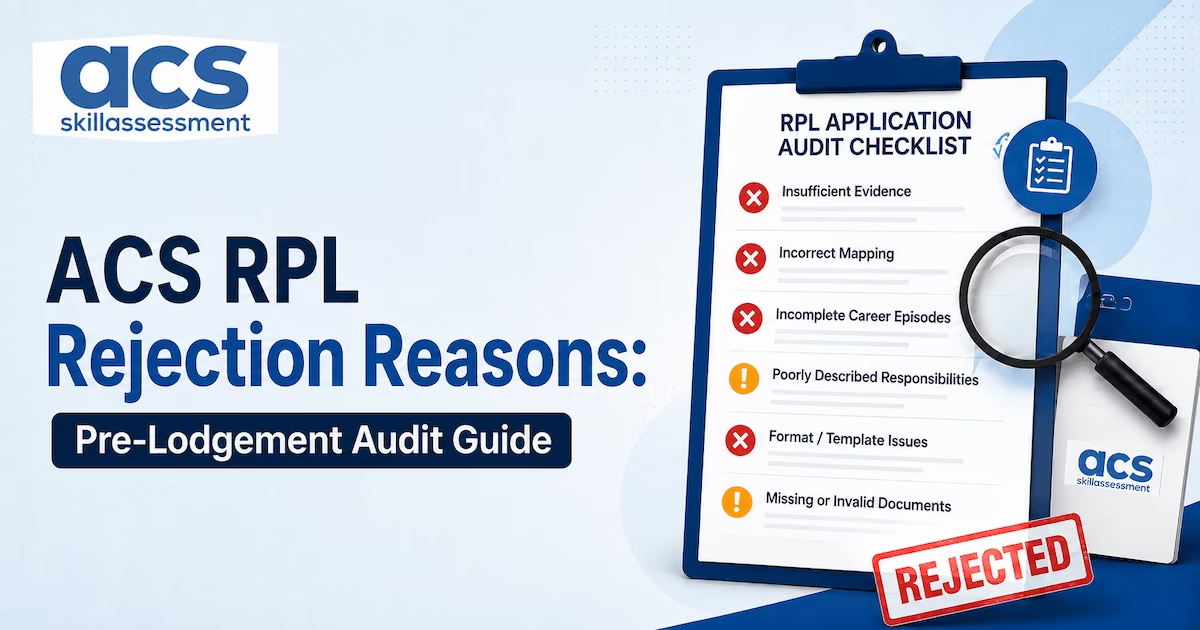
You pay the fee, wait four to six weeks, and the result letter reads "Not Suitable." Almost all ACS RPL rejection reasons are visible in your own file before an assessor opens it. The Australian Computer Society treats a Recognition of Prior Learning submission as a structured evidence case, held to the same standard as a formal qualification, so a thin or misaligned application fails on requirements you could have checked yourself. What follows is a pre-lodgement failure-mode audit: each trigger is mapped to the ACS requirement it breaks, and the piece closes with a self-check you can run before you spend a cent.
What ACS Assessors Actually Score in an RPL Application
The five ACS RPL evaluation criteria and how each shapes the outcome
One line on the ACS assessment-process page reframes the whole exercise: the assessment "is underpinned by SFIA," the Skills Framework for the Information Age. Assessors are not tallying how often the word "network" appears in your CV. What they judge is whether each block of employment demonstrates professional ICT competency at a SFIA-appropriate level for the occupation you nominated.
ACS scores an RPL submission against five published evaluation criteria. Understanding all five matters because a file that is strong on four and weak on one still fails.
1. ICT-relevant employment, your work history must demonstrate hands-on ICT duties that map directly to your nominated ANZSCO occupation unit, not peripheral IT involvement or generic management.
2. Recency of experience, ACS applies a 10-year lookback window; only experience within that window is assessed. Within that window, your most recent qualifying role must fall within the last two years at a minimum of 20 hours per week.
3. Project reports, two written project reports are required: one completed within the last 24 months and one within the last 48 months. Each must demonstrate SFIA-level competency in narrative form, not simply assert it.
4. Professional currency, separate from your work history, you need at least two accepted forms of evidence showing current knowledge in your nominated occupation, such as qualifying vendor certifications on the ACS accepted list.
5. Reference documentation, every employment period you claim must be supported by compliant reference letters or statutory declarations that carry employer name, exact dates, position title, task-level ICT duties, and a contactable supervisor.
The ANZSCO code anchors the whole assessment. A claim under 261313 Software Engineer is read for hands-on design, build, and testing competency. The same duties submitted under 135101 ICT Manager are read for planning, budget ownership, and decision autonomy, a higher band of responsibility on the SFIA scale. Describe a management role in purely technical task language, or a hands-on role in vague leadership language, and the evidence contradicts the level the code expects.
Our ACS eligibility, documents, and process guide lays out the documentation requirements for each criterion. Every major rejection trigger traces back to one of these five gates, and all five are checkable before you pay.
Vague Work Experience That Fails the ICT-Relevance Test
"Responsible for IT operations and team leadership" tells an assessor nothing they can verify. It names a job, not a competency. ACS credits duties, not titles, and every duty has to read as something a person in your nominated ANZSCO occupation actually does.
How to write task-level descriptions an assessor can verify against ANZSCO
Pull each responsibility down to the task an assessor could picture and match to the occupation description. "Team leadership" becomes "led a five-person team through the migration of 40 on-premises application servers to AWS, owning the cutover runbook and rollback plan." The second version carries a verb, a scope, a technology, and an outcome. Apply that pattern across the bulk of your duties, and the ICT-relevance criterion looks after itself. Leave them as titles, and the assessor has nothing to score against Criterion 1.
Skills Claims That Don't Align With the ACS ICT Skills List
The ACS ICT Skills List is the official publication that defines which competencies belong to which occupation. Assessors use it as the reference against which your claimed skills are matched to your nominated ANZSCO unit. Claim a skill set that sits under a different occupation, and that competency block gets discounted, which can drag your assessed experience below the threshold and trigger rejection.
Matching your competency claims to the correct ANZSCO occupation unit
Anchor the claim to the code. Evidence for 262113 Systems Administrator should read as infrastructure operations, not application development. If your real work straddles two occupations, that used to force a compromise into the nearest single code. Since early 2025, you can nominate up to three ANZSCO codes in one application for a single fee and receive a separate outcome for each, and ACS's updated ICT Skills List added ten new ICT occupations to the assessable list. Roles that never had a clean home, including Cyber Security Engineer (261315), DevOps Engineer (261316), and Data Scientist (224115), now have exact codes. Anyone rejected pre-2025 for a forced code mismatch should recheck the current list before assuming their old occupation was the real problem.
Unexplained Employment Gaps in Your Work History
A gap between roles is not automatically a problem. An unexplained gap is. When your timeline shows six months, a year, or longer between employers and your file offers no account of that period, assessors flag it under Criterion 1 and Criterion 5 simultaneously: the ICT-relevant experience count stops, and the reference documentation for the surrounding periods may be scrutinised more closely.
What supporting evidence ACS accepts to close a gap
The documentation required depends on what the gap actually was. A career break for family or health reasons can be covered by a statutory declaration from you stating the nature and duration of the break, witnessed by an authorised official. Freelance or contract work during a gap needs client letters or contracts that meet the same task-level standard as employment references. Study periods are documented with enrolment records. Tax records and bank statements showing no employment income during the period can corroborate the picture when formal documentation is thin.
The key is that every period in your timeline should be accounted for. Leaving a gap undocumented does not hide it; it signals to the assessor that your file is incomplete and invites closer scrutiny of everything around it.
Experience Outside the 10-Year Assessment Window
ACS applies a strict 10-year lookback window. Experience more than a decade before your submission date is not assessed, regardless of how senior or relevant the role was. For an application lodged in mid-2026, only experience from mid-2016 onward counts toward your assessed total.
Which roles count and when older experience can still be cited
In practice, the window means that a professional with 18 years of ICT experience may only have 10 assessable years, and a subset of those may be discounted for recency or concurrency reasons (see below). Plan your application around the window, not your total career length.
ACS does recognise exceptional circumstances under which experience outside the 10-year window may be referenced, but this is narrow. The bar is high and must be documented explicitly; it is not a general softener for old careers. If your assessable experience within the window is borderline, the better investment is strengthening the evidence for what falls inside it rather than arguing for exceptions to what falls outside.
The Timing Gates: Recency and How Experience Is Counted
Total years are what applicants track. It is not the number that fails them. Two timing rules quietly disqualify otherwise strong files.
Recency is the first. Your most recent qualifying role must be active or have ended within the two years before submission, at a minimum of 20 hours per week. An applicant with a decade of relevant ICT experience whose last qualifying role ended three years ago fails this gate regardless of how strong the earlier years look. If you have taken a career break, resolve this before you lodge.
Concurrent employment is the second. Overlapping roles count only once toward your total. Hold two jobs simultaneously for two years, and ACS credits two years from that period, not four. If you plan to lean on an overlap to reach a threshold, the arithmetic will not cooperate, so nominate the role with the stronger, better-documented ICT duties as the one that carries the period.
Reference Letters That Lack the Detail ACS Requires
A reference letter is where good experience goes to die, because applicants treat it as a formality and ACS treats it as primary evidence for Criterion 5. Each letter must carry the employer's name, your exact employment dates, your position title, task-level ICT duties (not a one-line summary), and the name and direct contact details of the supervisor attesting to the work, ideally on company letterhead.
When your employer refuses to sign
Applicants at hostile or defunct former employers do not need to panic. ACS accepts a statutory declaration, witnessed by an authorised official, from a colleague who can describe the working relationship, the duties you performed, and your employment dates. It carries evidentiary weight when a company reference is genuinely unobtainable, provided it holds the same task-level detail a formal letter would. A difficult exit does not have to cost you the period.
Missing Professional Currency Evidence
Most applicants do not know this criterion exists as a standalone gate. Separate from your work history and your project reports, ACS requires a minimum of two forms of professional currency evidence proving you hold current knowledge in your nominated occupation. Qualifying vendor certifications are the cleanest way to satisfy it, but only certain certifications appear on the ACS accepted list. A file that is strong on history but shows no recent, verifiable currency can be marked down on Criterion 4 alone, so confirm your certifications qualify rather than assuming any badge counts.
Documents That Contradict Each Other
Assessors cross-check. When your CV says a role ran to March 2022, the reference letter says June, and your visa history implies you had already left the country, the file stops being an evidence case and becomes a puzzle, and puzzles get rejected. Before lodging, reconcile every date, title, and employer name across your CV, reference letters, payslips, and identity documents. One inconsistency gives the assessor reason to distrust the rest.
Proving Competency With a Job Title Instead of Evidence
"Senior Network Engineer for eight years" is a claim, not proof. The RPL exists precisely because you have no Australian qualification to stand in for the competency, so the burden sits entirely on the evidence to demonstrate the skill directly. Translate each responsibility into a demonstrable ICT skill: not "managed security," but "designed and enforced the firewall ruleset and ran quarterly penetration tests against the DMZ." The project reports are where this lands hardest, since they are your opportunity to show SFIA-level competency in narrative form rather than assert it.
When RPL Is the Wrong Pathway Entirely
Some rejections happen because the applicant chose the wrong assessment route. Holding an ICT degree from an institution ACS recognises means the qualification-based pathway assesses that degree directly, and it is both faster and lower-risk than reconstructing competency from employment evidence. RPL is designed for professionals without a recognised ICT qualification, not as an alternative to using one. Choosing it when you have an assessable degree adds evidentiary burden for no benefit. Our guide to the ACS skills assessment pathways walks through the decision before you commit.
How to Self-Audit the Most Common ACS RPL Rejection Reasons
This pre-lodgement checklist is built from ACS's five published RPL evaluation criteria so you can score your own file before paying the assessment fee. A single "no" is a trigger to fix before you lodge.
Criterion 1, ICT-relevant employment
- Does the bulk of your claimed experience map to the duties of your nominated ANZSCO unit on the ACS ICT Skills List?
- Are your work descriptions written at the task level, with verbs, scope, technology, and outcome, rather than as title summaries?
- Are all employment gaps in your timeline documented with statutory declarations, client letters, enrolment records, or equivalent?
Criterion 2, Recency
- Does your most recent qualifying role fall within the last two years at 20 or more hours per week?
- After removing concurrent-role overlaps and experience outside the 10-year window, do your counted years clear the threshold for your qualification level?
Criterion 3, Project reports
- Do you have one project completed within the last 24 months and one within the last 48 months?
- Do both reports demonstrate SFIA-level competency through specific decisions and outcomes, not just task lists?
Criterion 4, Professional currency
- Do you have at least two accepted forms of professional currency evidence?
- Do your certifications appear on the ACS accepted list, not just a general vendor list?
Criterion 5, Reference documentation
- Does every reference letter or statutory declaration carry employer name, exact dates, title, task-level duties, and a contactable supervisor?
- Are dates, titles, and employers consistent across every document in the file?
Run it twice: once yourself and once through someone who will be honest about the gaps.
ACS RPL Rejected: Your Review and Appeal Options
A "Not Suitable" outcome is not the end of the road, but the clock starts immediately, and Review and Appeal are two different instruments that applicants routinely confuse.
A Review is what most rejected applicants actually need. Lodge it within 60 days of your result letter, and it lets you submit additional documentation and request assessment under a different ANZSCO code. For rejections caused by missing evidence or a fixable code mismatch, this is your route.
An Appeal is narrower. It also runs on a 60-day deadline, but it contests procedural error only, and no new documents can be added. The fee is refundable if the appeal succeeds. ACS runs two appeal levels, each carrying its own fee on the ACS fee schedule, so confirm the current amounts on the ACS website before lodging, as they change without notice. Choose an appeal only when you believe ACS misapplied its own process, not when you simply have more evidence to add.
Two exceptions shape the rest of your options. Plagiarism is not an ordinary unsuitable outcome you can quietly re-lodge; a plagiarism finding can bar you from reapplying for a fixed period, so original project reports are non-negotiable. On a successful outcome, note also that a Suitable result is valid for two years with no renewal, so lodging years before you intend to use it wastes the validity window. Fixing these ACS RPL rejection reasons before you lodge is far cheaper than any appeal fee.
Before you lodge or re-lodge, work through our ACS Skills Assessment Document Checklist, which covers every supporting document ACS verifies against each RPL section. Catching a gap there costs you nothing. Catching it in a result letter costs you the fee and months.
FAQs
Can I reapply for ACS RPL after a rejection, and is there a mandatory waiting period?
For most unsuitable outcomes, there is no mandatory waiting period. You can lodge a Review within 60 days of your result letter or reapply with a strengthened submission. The exception is a plagiarism finding, which can carry a fixed reapplication ban, so treat original content as mandatory.
Will ACS send a detailed written explanation of why my RPL was rejected?
Not a line-by-line critique. The outcome letter states the decision and generally the experience and dates ACS did or did not credit, but it will not annotate every weakness. You diagnose the failure by comparing what was credited against what you claimed, which is exactly why a pre-lodgement audit against all five criteria matters.
Does an ACS RPL rejection affect my ability to switch to the formal qualification pathway instead?
No. A rejected RPL does not close the qualification-based pathway. If you hold an ACS-recognised ICT degree, that route assesses your qualification directly and is often the one you should have used first. The pathways are independent, so a rejection on one does not disqualify you from another.
Can I submit a statutory declaration if my former employer refuses to provide a reference letter?
Yes. ACS accepts a statutory declaration from a colleague who can attest to your role, duties, and employment dates, witnessed by an authorised official. It stands in for a company reference when one is genuinely unobtainable, provided it carries the same task-level detail ACS expects from a formal letter.
If my ACS RPL is rejected, what happens to the points I claimed in my SkillSelect EOI?
Your skills-assessment points depend on a Suitable ACS outcome. Without one, you cannot substantiate the ACS component of your points claim, so any Expression of Interest resting on it is unsupported and should be corrected. The EOI itself is managed by the Department of Home Affairs, not ACS, so update your claim there once your assessment status changes.