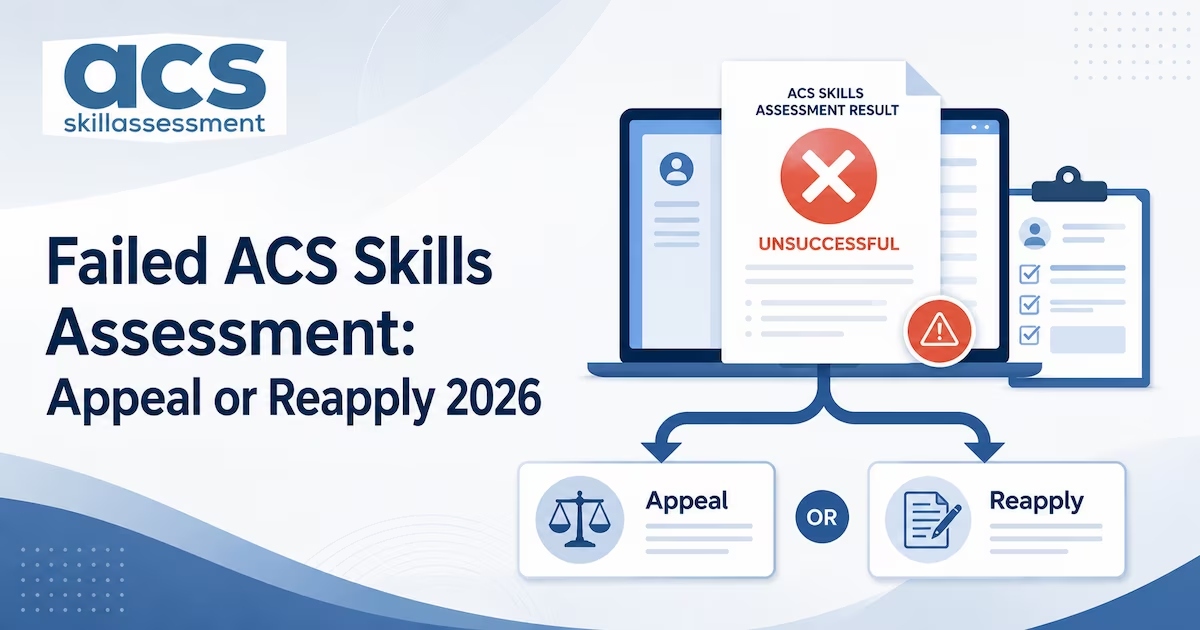
A single word in your outcome letter carries all the weight: 'unsuccessful.' A failed ACS skills assessment triggers the same reflex in most applicants: lodge an appeal by Friday or rush a fresh application the same week. Both can be the wrong call. The correct one turns entirely on why the Australian Computer Society marked your application down, and that reason is already spelled out in the letter in front of you.
This guide covers the two genuine options, appealing the decision and reapplying from scratch, with the fees, deadlines, and document fixes ACS actually publishes. It also covers the case most guides skip: when neither path is worth your money.
What Your ACS Skills Assessment Outcome Really Means
Your outcome letter is not a generic rejection slip. It names the exact ground your application failed on, and that ground decides whether an appeal has any chance or whether you are better off rebuilding the submission.
Where the rejection grounds sit in the letter
Scroll to the assessment summary, below your nominated ANZSCO code and the list of qualifications ACS recognised. That block states which qualification was found non-comparable, which employment episodes were discounted, and whether your degree was judged relevant to the occupation you nominated. Do not act on the one-line result at the top. The reasoning underneath it is what you are appealing or fixing.
The three grounds ACS cites most
Most unsuccessful outcomes trace to one of three findings.
First, a qualification assessed as not comparable to an Australian bachelor degree or higher, or in a field ACS does not accept for your nominated code. Second, insufficient ICT content in your claimed employment, where ACS could not see enough genuine ICT tasks in the duties your references described. Third, weak relevance between your education and your nominated occupation, so the degree and the job code simply do not align.
Which one applies to you changes the entire decision that follows. A comparability finding is hard to overturn on appeal. A discounted employment episode caused by a thin reference letter is often fixable in a new application.
Deciding Between an Appeal and a New Application
When a Level 1 Appeal is worth lodging
Appeal when you can point to a specific assessing error, not just disappointment. ACS reviews the decision against the evidence you already filed. An appeal is strongest when your original pack was complete and you believe an assessor misread it: an employment episode dismissed despite clear ICT duties, or a qualification outcome that contradicts how ACS treats comparable degrees.
If your case is 'I should have included more,' that is a reapplication, not an appeal argument.
When a fresh application is the stronger move
Reapply when the problem was your evidence, not the assessor's reading of it. A reference letter that never spelled out day-to-day ICT tasks, a missing transcript, an employment period you could not document at the time: these are gaps you close by submitting again with better material. Reapplication costs more and takes longer, but it lets you rebuild the weak part instead of defending a pack that was genuinely short.
Appeal versus new application, side by side
Criterion | Level 1 Appeal | New application |
|---|---|---|
Fee (excl. GST) | $516 | $1,498 |
Time to outcome | 2 to 4 weeks | 4 to 6 weeks |
New evidence | Not accepted, challenges the existing decision on the file already lodged | Full rebuild from scratch |
Best suited to | A genuine assessing error on evidence already filed | A real evidence gap you can now fix |
All figures exclude GST and reflect the ACS fee schedule effective 3 November 2025. Processing timeframes are per ACS published processing data. The appeal is cheaper and faster, but it only pays off when the original decision was wrong on the evidence you filed. When the evidence itself was the problem, a new application is the honest fix even at roughly three times the fee.
How to Lodge an ACS Skills Assessment Appeal
First, the terminology. ACS runs a two-stage appeal: Level 1 and Level 2. Several competitor guides describe a separate 'review' that lets you add new documents, distinct from an 'appeal' that does not. ACS's own published pages do not use that split. Treat the process as ACS names it, Level 1 Appeal first and Level 2 Appeal only if that fails.
Grounds ACS accepts for an appeal
An appeal has to identify a defect in the assessment: a process error or evidence ACS did not weigh correctly. Simple disagreement with the result is not a ground. Before you lodge, write one sentence naming the specific finding you are challenging and the evidence already on file that contradicts it. Without that sentence, the fee is unlikely to buy you a different result.
The appeal fee, payment, and the refund rule
A Level 1 Appeal costs $516 (excl. GST); a Level 2 Appeal costs $620 (excl. GST), per the ACS fee schedule effective 3 November 2025. Payment goes through the ACS portal when you lodge.
The refund position matters for your cost-risk calculation, and it is conditional. ACS states: 'ACS may refund the cost of an Appeal if the assessment decision is overturned.' Read the word 'may.' A refund is not guaranteed even when you win, and nothing is returned if the original decision stands. Competitor pages that promise the fee is 'refunded if successful' overstate it.
What to attach to a Level 1 Appeal
Keep the submission tight and aimed squarely at the finding you named. Include your outcome letter reference, a clear statement of the ground you are challenging, and pointers to the exact evidence already in your file that supports your position.
Do not treat an appeal as a route to add documents you forgot the first time. Reliance on new material is the signal that a new application is the cleaner path.
Processing time and the 30-day Level 2 window
A Level 1 Appeal takes roughly two to four weeks, per ACS published processing data. If it fails, you have a hard 30 days from the Level 1 outcome letter to lodge a Level 2 Appeal, which goes to a different assessor. Miss that window and the escalation route closes. The Level 1 lodgement deadline is 60 days from your original outcome letter, so do not delay the decision.
How to Reapply After an Unsuccessful ACS Assessment
A new application is a clean slate at the full pathway fee of $1,498 (excl. GST). That price only earns its keep when the second submission fixes what sank the first. Resubmitting the same pack with a cover note is not a strategy.
Fixing the specific gaps, not generic strengthening
Return to the three grounds and work from there. Employment episodes get discounted for a predictable reason: the reference letters do not describe genuine ICT duties in enough detail for an assessor to map them to your nominated code.
ACS requires references from the employer directly or, for agency placements, from the host company rather than the recruiter. The letter has to name your actual tasks, show technical depth, and confirm the role met the 20-hours-per-week minimum ACS treats as full time. A generic HR letter confirming your dates and job title is exactly what gets episodes cut.
What to change in your CDR or RPL
On the qualification and knowledge side, precision beats volume. Tighten each career episode so it foregrounds your personal ICT decisions and technical contributions, not the team's output, and demonstrates the depth ACS looks for rather than reading as a project narrative. Where comparability was the finding, add full academic transcripts, subject descriptions, and any credential-recognition documentation you hold, so ACS can map your subjects to an Australian standard.
Our best CDR writers in Australia roundup covers when paid help is worth it and what a good writer actually fixes in a weak career episode.
Casting a wider occupational net
One reapplication strategy competitor pages miss: the ACS portal now lets you nominate up to three ANZSCO codes in a single application at one fixed price. If your rejection came from a marginal code match, this is a low-cost way to test your profile against related occupations at once rather than gambling everything on a single code again.
Priority processing is available free of charge when your visa deadline falls within 12 weeks of the application date, provided you give at least two weeks' notice. Pick the right pathway before you file. Our ACS skills assessment pathways guide walks through which route fits which background.
When Neither an Appeal Nor a New ACS Application Fits
Some rejections signal that you are in the wrong queue. Repeating the process will not change a structural mismatch.
A ban you need to rule out first
Before you plan any resubmission, check the specific reason. Document fraud, plagiarism, or misrepresentation can result in ACS imposing a reapplication ban with no fee refund. In that situation, reapplication is not a decision you get to make. Get professional migration advice before you touch the portal again.
Assessing bodies outside ACS
Engineers Australia assesses several engineering-adjacent occupations that overlap the ICT space, and its comparability rules differ from ACS's. An applicant whose degree ACS reads as non-comparable may be a clean fit under the right assessing body. That is not a workaround; it is choosing the authority that actually matches your training and your nominated occupation.
Visa routes that skip skills assessment
Not every skilled visa path hinges on an ACS outcome. Certain employer-sponsored and talent-based streams weigh the assessment differently, or not at all. If the ACS route is a genuine dead end for your profile, a registered migration agent can identify whether a different visa class reaches your goal without the assessment that rejected you.
Common Questions After a Failed ACS Skills Assessment
Can I appeal just because I disagree with the outcome?
No. An appeal has to identify a specific process or evidence error, not general disagreement with the result. ACS reviews the decision against the material you already filed, so you need to name the finding you are challenging and point to evidence on file that contradicts it. Without that, the fee rarely produces a different outcome.
How much is the ACS appeal, and is the fee refunded if I win?
A Level 1 Appeal is $516 (excl. GST), and a Level 2 Appeal is $620 (excl. GST), effective 3 November 2025. The refund is conditional: ACS states it 'may refund the cost of an Appeal if the assessment decision is overturned.' It is not automatic even when you succeed, and nothing is returned if the original decision stands.
Is there a deadline to lodge an appeal?
Yes. A Level 1 Appeal must be lodged within 60 days of your outcome letter date. If Level 1 fails, you have 30 days from that outcome to lodge a Level 2 Appeal. Miss either window and the escalation route closes, leaving a new application as your only remaining path.
If my appeal fails, how long before I can reapply?
ACS does not publish a mandatory waiting period for a standard unsuccessful outcome, so you can generally submit a new application once you have stronger evidence ready. Cases involving fraud or misrepresentation may carry a reapplication ban. Confirm your specific situation before assuming the door is open.
Can I switch pathways when I reapply?
Yes. A new application lets you nominate a different pathway or occupation, and the portal now allows up to three ANZSCO codes in one submission at a single fixed fee. If your first attempt failed on a marginal code match, testing related occupations together is usually smarter than repeating the same single-code application.
Does a previous unsuccessful assessment hurt a new application?
A new application is assessed on its own evidence. A prior unsuccessful outcome does not by itself count against the result. What matters is whether the second submission addresses the gaps that sank the first. The exception is an integrity finding, which can carry consequences beyond a single assessment cycle.
Before you pay another fee, make sure the next submission has nothing left to trip on. Read the complete ACS skills assessment document checklist and confirm every reference, transcript, and career episode meets ACS's requirements before you file.