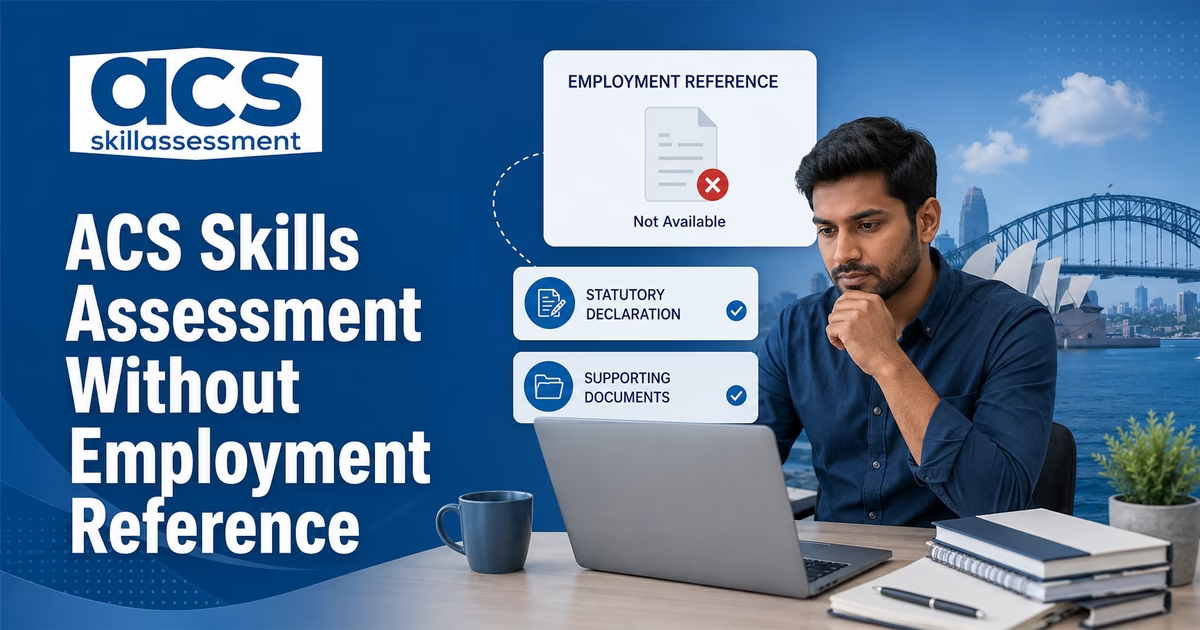
An ACS skills assessment without employment reference still has a path forward, but it is narrower than most migration blogs suggest. Whether it works turns on one rule ACS enforces without exception.
What ACS accepts when a standard reference is not available
For each employment period you claim, ACS requires at least two different types of documentary payment evidence: one set from the beginning of the period and one from the end, with at least one sourced from somewhere other than your employer. That independent-source requirement is the pivot. In every no-reference situation, the missing party is the employer, so a government tax document or a bank statement showing salary deposits is what keeps the period assessable at all.
The ACS InfoHub employment references page gives exactly one sentence to your situation: where a standard reference cannot be obtained, a statutory declaration may be provided instead. It does not specify which scenario you are in, what corroboration you need, or when the attempt is simply futile.
Read that position carefully. A statutory declaration is not a lighter version of a reference. ACS does not treat the two as equivalent, and the bar is arguably higher: ACS flags declarations to the Department of Home Affairs for authentication against fraud and plagiarism. Treat it as a sworn statement that has to survive a fraud check, not as a convenient workaround.
Which scenario applies to your situation
ACS recognises four situations where the standard reference genuinely cannot be produced. Each routes to a slightly different evidence path. Identify yours before you draft a word. If you are weighing which route fits your history, our ACS pathways explainer sets out how each is assessed.
Your former employer's company has closed or been dissolved
When the company no longer exists, there is no letterhead and often no one authorised to sign. A former managerial or supervisory colleague who overlapped with you can still give a statutory declaration, but only if they also supply their own Employment Certificate, Statement of Service, or Leaving Certificate on that company's official letterhead.
If nobody survives who can produce that document, the path narrows fast. Your independent evidence becomes the load-bearing element: the tax records and bank statements from that period are what give the assessor anything to work with.
Your employer refuses to provide a reference or stops responding
A living, reachable employer who simply will not cooperate is the most recoverable of the four scenarios. You still route through a colleague's declaration plus their own service document, and your payslips and tax records cover the independent-source half of the rule. Make one more genuine approach to the employer before you commit to this path. Even partial cooperation, a single letter confirming your dates and title, strengthens the file materially.
Your employer is based overseas and will not cooperate
An overseas employer adds a witnessing complication the other scenarios do not carry. An Australian Justice of the Peace cannot witness a declaration signed abroad. The ACS InfoHub directs applicants outside Australia to follow local legal standards or consult an Australian Embassy. In practice, that means identifying the local equivalent of an authorised witness, usually a notary public, or using an Australian consular officer. Settle the witnessing question before you book anything else.
You were self-employed during the period you are claiming
Here you need no colleague. Self-employed applicants may write their own statutory declaration, and the evidence path is entirely different from the employee route. You need your business registration certificate (an Australian Business Register entry or its overseas equivalent), an accountant or legal practitioner statement, client statements describing the work, invoices, Business Activity Statements (BAS statements) covering the relevant periods, bank statements, tax records, and your client or supplier contracts. You are both applicant and declarant, which places more weight on independent corroboration than in any other scenario.
Preparing a statutory declaration ACS will take seriously
Who can give and sign the statutory declaration
For an employed period, the declaration must come from a managerial or supervisory colleague whose employment overlapped yours. A junior colleague, or anyone who cannot show they worked alongside you in that capacity, is rejected outright. The document must be signed before an authorised witness and carry the exact words Sworn Before, Signed Before, or Witnessed Before, followed by the witness's signature, date, and location.
Miss that phrasing and the declaration is unsuitable regardless of its content. Inside Australia, accepted witnesses are a Justice of the Peace, a solicitor, or a notary public. Outside Australia, use the local legal equivalent or an Australian consular officer. One further requirement catches many applicants: the colleague who signs must attach their own current Employment Certificate, Statement of Service, or Leaving Certificate on company letterhead. Their account of your role is only accepted alongside proof of their own.
What your statutory declaration must describe
Write it in the declarant's voice. State your position title, the exact employment dates in DD/MM/YYYY format, salary, hours, and the duties you genuinely performed, plus a plain explanation of why the standard reference is unavailable. Duties copied from the ANZSCO description are a known disqualifier. The assessor wants lived specifics: the systems you administered, the projects you delivered, the team structure you worked within. A pasted code definition tells them nothing a fraudulent submission could not also say.
Supporting documents to submit alongside the declaration
Organise these around the dual-source rule, not as a flat pile of whatever you can find.
Primary evidence: payslips, tax returns, and employment contracts
Your employer-side documents are payslips, signed employment contracts, and project work orders or purchase orders. These establish the role and the relationship. One important carve-out: employment contracts and offer letters are not accepted as payment evidence, and cash payments are not accepted at all. A contract proves you were hired. It does not prove you were paid across the duration of the period, which is precisely what the payment rule tests.
Secondary evidence: project files and client letters
The independent half of the dual-source rule is satisfied by government tax records and bank statements showing salary deposits, because these originate outside the employer. For a country with no income tax system, ACS may accept a government-issued work permit showing employer name and dates. Project files, client correspondence, and HR system exports add texture and can corroborate your duties, but they are secondary. They support the claim; they do not replace an independent payment record. Cross-check the full set against our ACS eligibility documents guide so nothing structural is missing before you lodge.
How to submit your application when the standard reference is missing
Where and how to document the gap in your ACS portal submission
Upload the statutory declaration in place of the reference, the declarant's own service certificate, and your primary and independent evidence together. Include a short covering note explaining why the standard reference could not be obtained. One rule reshapes your entire preparation sequence: additional documentation cannot be added once a General Skills application is submitted. There is no top-up mechanism after lodging. Everything must be complete and correct on day one, which for an alternative-evidence file means collating more, and doing so earlier, than a standard submission would require.
How unusual evidence affects ACS processing time
A clean General Skills application runs four to six weeks. An alternative-evidence submission is more likely to trigger a request for information, and once that happens, ACS sets no upper bound on the timeline. If you are working toward a visa deadline, build that uncertainty in now rather than after the request arrives.
How ACS assesses alternative evidence and where applications fail
What an assessor looks for when making a discretionary call
The assessor is deciding two things: whether the independent record and the sworn account agree with each other, and whether the declarant is credibly senior to you and demonstrably present at the same employer during the same period. Acceptance is explicitly discretionary. ACS does not guarantee it and has rejected periods where the corroboration was too thin to support the declaration. The Home Affairs fraud check sits behind that discretion, which is why a declaration that overreaches past what the documents actually show is worse than a modest one that stays within them. Many of the same weaknesses appear in our self-audit of common ACS rejection reasons.
Employment periods that cannot be assessed at all
Some periods cannot be saved by any submission. If a dissolved employer left no payslips, no tax records, no contract, and no surviving colleague who can both sign a declaration and produce their own service certificate, no combination of documents meets the dual-source standard. A documented case on the AM22Tech forum shows ACS excluding dissolved-company periods on exactly these facts while still assessing the applicant's more recent, documented experience. Name this possibility to yourself honestly before you pay the assessment fee, because no amount of careful drafting substitutes for evidence that never existed.
The cost of a rejected alternative-evidence submission
Run the numbers before you lodge. A General Skills assessment costs AUD 1,498 on ACS's current fee schedule (effective November 2025). If your alternative evidence is judged too thin, a Level 1 appeal costs AUD 516 and a Level 2 appeal costs AUD 620, with each stage adding its own weeks on top of the delay already absorbed. Pursue the assessment and both appeal levels in sequence and you are looking at roughly AUD 2,634 in fees, plus months against a visa timeline that may not have months to give.
Set that against one more genuine attempt at partial employer cooperation. A single letter on company letterhead confirming your dates and title, well short of a full reference, can convert a discretionary gamble into a routine assessment. If a former manager is reachable and merely reluctant, the hours spent chasing that letter cost less than a rejected file and an appeal cycle. If the company is gone and no colleague survives, spend nothing on a submission the evidence cannot support. That is the calculation an ACS skills assessment without employment reference ultimately turns on.
Questions about an ACS skills assessment without employment reference
Can I submit my ACS skills assessment with no employment references at all if I have payslips and a contract?
Not on payslips and a contract alone. ACS still expects a statutory declaration to stand in for the missing reference, and the payment rule requires two evidence types per period with at least one from outside the employer. A contract is not payment evidence, so you need payslips plus an independent record such as tax documents or bank statements, alongside a declaration that describes the role.
What must a statutory declaration include to replace an ACS employment reference?
It must state your position title, exact dates in DD/MM/YYYY format, salary, hours, and your actual duties, plus an explanation of why the standard reference is unavailable. It must be signed before an authorised witness and carry the words Sworn Before, Signed Before, or Witnessed Before with the witness's signature, date, and location. Duties lifted from the ANZSCO description make it unsuitable.
Does the statutory declaration need to come from a former manager, or can a colleague sign it?
For employed periods, it must come from a managerial or supervisory colleague whose employment overlapped yours, not a junior peer. That person must also attach their own current Employment Certificate, Statement of Service, or Leaving Certificate on company letterhead. Only self-employed applicants may write and sign their own declaration.
What happens if the company I worked for has been dissolved and no one is available to sign anything?
The period may be unassessable. Without a colleague who can both sign a declaration and supply their own service certificate, and without independent payment records from that time, there is no combination that meets the dual-source standard. A documented forum case shows ACS excluding dissolved-company periods on exactly these facts while still assessing the applicant's recent, documented experience.
Will ACS reject my application outright if I submit only a statutory declaration with no supporting documents?
A bare declaration with no corroboration is a genuine rejection risk. ACS treats the declaration as discretionary and cross-checks it against independent evidence and a Home Affairs fraud authentication. If nothing backs the sworn statement, the assessor can decline to count the period entirely.
How does self-employment evidence differ from a standard employment reference in an ACS application?
Self-employed applicants write their own declaration and prove the work through business registration such as an ABR entry, an accountant or legal practitioner statement, client statements, invoices, BAS statements, bank statements, tax records, and client or supplier contracts. There is no colleague reference and no company letterhead; the corroboration comes from your registration, your clients, and your financial records.
Before you submit, cross-check every other document in your file against the full ACS document checklist so a separate gap does not cause a delay alongside the missing reference.