Your ACS result letter says "unsuccessful," and a 28-day clock started the day it was dated. That window decides whether a formal ACS skills assessment appeal stays open or closes for good. Miss it, and the only route left is a fresh application at full cost. This guide maps each rejection reason to the pathway that actually fixes it, so the next few weeks go to the right move.
What an unsuccessful result means and why 28 days matters
An unsuccessful result, a formal determination rather than a suggestion, carries two dates that govern everything after it: the date printed on the decision letter, and the 28-day deadline that date sets running.
The letter date starts a clock you cannot pause
Confirm that date the moment your result arrives, because it, not your reaction time, sets the deadline. Twenty-eight days run from the date on the letter, not the day you opened the email or noticed the result in your portal. If day 28 lands on a weekend or public holiday, treat the last business day before it as your real cutoff and lodge early. ACS does not extend this window. Once it lapses, your formal appeal rights for that decision are gone, and only a fresh reassessment remains.
Three routes, and only one order to use them
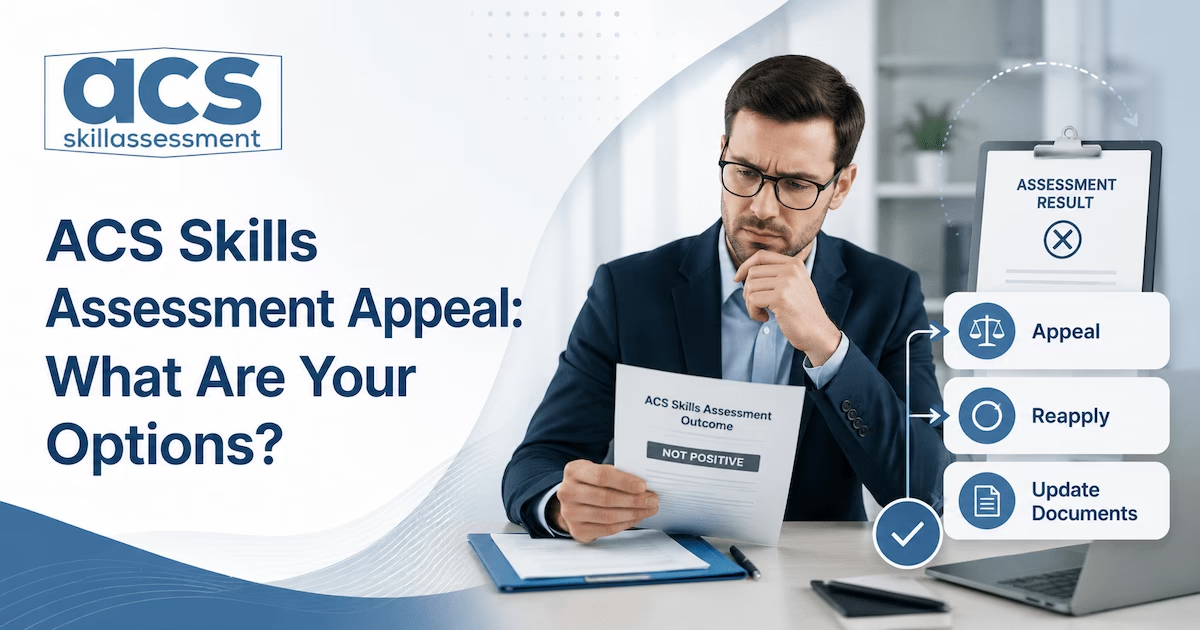
An ACS skills assessment appeal is really three separate routes, and they run in a set order:
A Level 1 review, an internal reassessment by a senior assessor who had no hand in your original file.
A Level 2 appeal, an escalation to an independent external reviewer that opens only after a Level 1 outcome.
A full reassessment, a brand-new application that replaces the appeal path entirely.
You cannot skip straight to Level 2, and choosing reassessment is a decision to stop appealing. Which one fits depends entirely on why you were refused.
Level 1 ACS review: requesting an internal reassessment
A Level 1 review asks a second senior assessor to check your decision for errors in the assessment or in the administration of your application. Its scope is narrower than most applicants expect, and that scope decides whether the fee is worth spending.
What a Level 1 review can actually overturn
Reviewable errors include a miscalculated experience tally, an ANZSCO code mapped to the wrong occupation when your evidence clearly pointed elsewhere, and administrative slips such as the wrong pathway applied to your file. What a Level 1 will not disturb are subjective calls: whether your duties were "relevant" enough, or whether your degree is equivalent to the required level. Those are judgment rather than error, and a Level 1 rarely moves them. Read your letter for which kind of finding you actually received.
New evidence is allowed, but it can cost you the refund
Here ACS's published policy differs from what several guides claim. At Level 1, you may submit additional evidence that was not in your original application. The catch sits in the refund rules: if your appeal succeeds because the assessor made an error, ACS refunds the fee in full; if it succeeds because new evidence changed the outcome, ACS reserves the right to keep the fee; and if the review upholds the original decision, there is no refund at all. New evidence therefore turns a potentially free correction into a paid one, which matters most when documentation was the real problem.
Fee, submission, and timing
The Level 1 appeal fee is $516 (excluding GST) under the ACS fee schedule revised in November 2025. Lodge the request through your existing ACS application, state precisely which finding you are challenging, and point to the exact evidence already on file that supports your case. ACS quotes roughly two to four weeks for appeal processing, though some third-party guides cite around 30 days, which you should treat as an estimate rather than an official service standard.
Level 2 appeal: escalating to an independent reviewer
You reach Level 2 only after a Level 1 outcome, and a new, separate clock starts the moment that outcome letter is dated.
The 28-day window that opens after Level 1
A Level 2 appeal must be lodged within 28 days of the date on your Level 1 outcome letter. This clock is separate from the Level 1 deadline and does not start until your Level 1 outcome is dated. Some service-provider pages apply a 60-day figure to the appeal stages, which is wrong and can cost you the escalation entirely.
An independent reviewer, and no new documents
Level 2 hands your file to an external expert independent of the ACS assessment team, brought in specifically to validate the Level 1 result. Two rules define it. No documentation can be added; the reviewer works from your original package only. Submit by email to level2appeal@acs.org.au, because there is no portal route for Level 2. The fee is $620 (excluding GST) under the ACS fee schedule, and processing can run up to 60 days. That delay is often the single longest hit to a visa timeline, so weigh it before you escalate.
Full reassessment: when a new skills assessment beats an appeal
Sometimes the fastest fix is not an appeal at all. When your rejection stemmed from evidence that was genuinely thin, a fresh application addresses the cause directly rather than contesting a decision built on weak material.
What a reassessment lets you add that a review will not
A new application accepts a rebuilt evidence package outright, with no refund penalty for using it, because it makes a stronger case from the start rather than contesting the old decision. The trade-off is cost: a fresh General Skills assessment carries its own fee under the ACS fee schedule, and it restarts your processing clock. When the problem is your evidence rather than the assessor's reading of it, that spend usually buys a better outcome than a Level 1 where you'd forfeit the refund anyway.
How to read your rejection letter to spot a reassessment case
Letter language signals which route applies. Phrases like "insufficient evidence of employment," "documentation provided did not demonstrate," or "the qualification submitted could not be verified" point to gaps in your original package. None of those findings can be overturned by a Level 1 review working from the same files. By contrast, phrases like "the nominated occupation does not align with," "the assessment period was calculated as," or "the incorrect pathway was applied" describe errors in how ACS read what you already submitted, and those belong at Level 1. If your letter combines both kinds of language, address each separately: the documentation gap through reassessment, the procedural error through Level 1 if time permits.
Matching your rejection reason to the right ACS skills assessment appeal pathway
This is where most guides stop, at a list of routes with no rule for choosing between them. A formal challenge only works when the route matches the reason. The mappings below are drawn from ACS's published appeal scope and refund policy, read against what your letter actually says.
Wrong ANZSCO code assigned by ACS
Go to Level 1. A code mapped to the wrong occupation despite supporting evidence is an assessor error, exactly what a Level 1 review exists to correct, and it needs no new documents. Win on that basis, and the fee is refunded in full. Among all available pathways, this is the cleanest and lowest-net-cost option, and the one most worth lodging quickly.
Insufficient work experience duration or relevance
Split the reason first. If ACS miscounted years you had already evidenced, that is an arithmetic error for Level 1. If the shortfall is genuine (you have more experience to evidence or stronger reference letters to collect), a full reassessment is the honest fix. A Level 1 built on new evidence would forfeit your refund and still leave a weaker file than a fresh application prepared properly.
Qualification not recognised or assessed at the wrong level
This one turns on error versus judgment. If ACS applied the wrong assessment level through an administrative slip, Level 1 can correct it. If the finding reflects a genuine equivalence judgment, Level 1 will not overturn it, and a reassessment rarely helps either. A Level 1 refused on that discretionary ground is the textbook case for a Level 2 appeal, where an independent reviewer, not the original team, takes a fresh look at the same evidence.
After a successful ACS appeal: EOI and points test effects
Winning restores your assessment, but it does not automatically rewind your migration clock, and that gap drives most of the urgency you are feeling.
What a reversed decision does and does not restore
A successful appeal reinstates your positive assessment outcome and its validity period. What it cannot do is recover the weeks the process consumed. If you had already lodged an Expression of Interest, update it to reflect the corrected result rather than assuming your earlier submission inherits the new outcome. If you had not yet lodged, a reversed decision lets you enter the pool with an accurate points position from the start.
Rebuilding a timeline the appeal has shifted
Level 1 processing runs two to four weeks, and Level 2 can take up to 60 days; those delays land squarely on invitation rounds and any state nomination deadline you were targeting. Before you appeal, check the next relevant rounds and whether your nomination carries an expiry, because a correct assessment that arrives after a deadline still costs you the cycle. Where a points threshold is close, model both timelines, the appeal and a fresh reassessment, and pick the one that reaches a valid EOI soonest, not simply the one that is cheapest.
Frequently asked questions about ACS review and appeal
Can I submit new documents with a Level 1 ACS review?
Yes. ACS policy lets you add evidence at Level 1 that was not in your original application. The cost is your refund: if new evidence is what changes the outcome, ACS reserves the right not to refund the appeal fee, whereas a win based on a genuine assessor error is refunded in full.
What happens if I miss the 28-day deadline to request a Level 1 review?
Your formal appeal rights for that decision close permanently. Neither Level 1 nor Level 2 stays available after that point, and your only route becomes a fresh reassessment at the full application fee. Because the deadline runs from the letter date, confirm that date the day your result arrives.
Does a Level 2 ACS appeal involve a different assessor than the original decision?
Yes. Level 2 is reviewed by an external expert independent of the ACS assessment team, brought in specifically to validate the Level 1 result. It sits above Level 1, which is itself handled by a senior assessor who took no part in your original decision.
Will appealing my ACS result delay my EOI lodgement or points test?
It can. Appeal processing runs roughly two to four weeks at Level 1 and up to 60 days at Level 2, and those weeks can overrun invitation rounds or a state nomination deadline. A successful appeal restores your assessment and its validity but does not claw back that time, so check upcoming rounds before you commit.
Is a Level 1 review worth requesting if ACS assigned the wrong ANZSCO code?
Usually yes. A wrong code applied against clear evidence is an assessor error, the core purpose of a Level 1 review, and it needs no new documents, so a successful outcome is refunded in full. Before you lodge, confirm that your submitted evidence genuinely pointed to the correct code.
Before choosing between a Level 1 review and a full reassessment, work through the ACS skills assessment document checklist. It often reveals whether your rejection was a documentation gap a new application can fix, or an assessment error the appeal process should challenge.