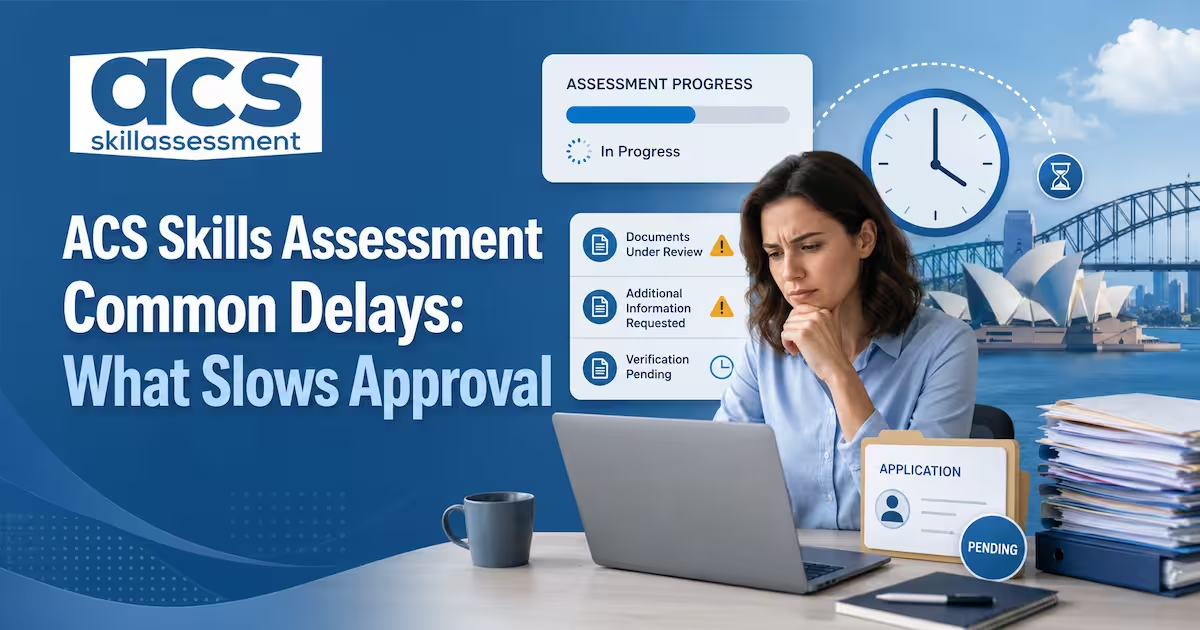
An ICT General application that should clear ACS in four to six weeks can sit for ten. That gap is rarely bad luck. Almost every instance of ACS skills assessment common delays traces back to a small set of mechanisms that legally pause or extend the review, and the most disruptive of them, a Request for Information (RFI), stops the clock outright rather than merely slowing it down. If you are timing a subclass 189 or 190 lodgement against an expiring English test or an age-points cliff, those extra weeks are the difference between an invitation and a missed round. This piece breaks down what actually drives deviation from the published estimate, and where you can intervene.
For the current official figures themselves, see our ACS skills assessment processing time guide. What follows is the layer underneath: why real cases run past them.
What ACS officially says about processing times
ACS publishes one headline figure. Per acs.org.au, standard processing runs four to six weeks for applications that require no additional documentation or information. That qualifier does a lot of work, and most applicants read straight past it.
ICT General: the four-to-six-week baseline
The 4-6 week estimate maps cleanly onto the ICT General pathway when your file is complete at lodgement and no assessor has a question. It assumes an ICT-major degree, employment references that reconcile against your payslips, and an off-peak queue. Treat it as the best version of your case, not the median one.
RPL: the eight-to-twelve-week baseline
ACS's own pages do not break out a pathway-specific number; the site states 4-6 weeks generically. The 8 to 12 week range widely quoted for the Recognition of Prior Learning (RPL) pathway comes from migration providers rather than ACS, and it reflects a real pattern. An RPL file rests on a project report that an assessor reads against competency criteria, which takes longer to evaluate and invites more follow-up than a degree plus a reference letter.
Why published estimates reflect best-case conditions
The stated window is a floor, not an average. It presumes the three conditions that most often fail: a complete and internally consistent document set, no RFI, and a queue that is not swollen by a seasonal surge. Miss any one, and your case slides toward, or past, the upper bound. The rest of this article explains which of those three tends to break, and by how much.
The Request for Information pause most applicants miss
The RFI is the single largest swing factor in an ACS timeline, and it is routinely misread as a warning sign. It is not. An RFI is a standard clarification step ACS uses when your evidence needs supplementing, and a well-prepared applicant can still receive a positive outcome after one.
What triggers an RFI and what ACS is checking
Most RFIs come down to verification. ACS cross-checks your employment reference letters against your payslips and tax records, so a reference that claims a role or date range your financial records do not corroborate draws a query almost automatically. Vague duty statements, gaps between claimed and documented employment, and a qualification ACS cannot confirm with the issuing institution are the other frequent triggers. In each case, the assessor is not rejecting you; the goal is to close a gap in the evidence before a ruling can be made.
How an RFI stops your processing clock entirely
Think of the review as a stopwatch, not a countdown. The clock runs from the day ACS receives a complete application, pauses the moment an RFI is issued, and does not resume until ACS logs your complete response. Time spent gathering documents does not count against the stated window, which sounds reassuring until you realise it also means the window never shrinks while you scramble. Providers commonly cite an RFI as adding two to six weeks to the overall timeline. You will also see a fixed 28-day response deadline quoted across third-party pages; that specific figure does not appear on ACS's current published pages, so plan around your own turnaround speed rather than a number ACS has not confirmed.
A worked example: one RFI, four weeks to twelve
Here is the arithmetic, built from ACS public process data. The clock starts the day ACS receives a complete application, payment confirmed and every document uploaded. Around day 14, an assessor issues an RFI because two payslips are missing for a claimed employment period. The clock pauses. You assemble corrected records and respond 21 days later. ACS logs the complete response, the clock resumes, and roughly 14 more days pass before a decision. Tally it: 14 running days, a 21-day pause, then 14 running days, so about seven to eight weeks on a case that should have closed in four to six. Add one resubmission cycle (say, ACS rejects an unsigned statutory declaration and waits for a witnessed version) and the same application realistically lands at ten to twelve weeks. That is our analysis of the public process, and no competitor page runs the numbers with ICT General as the input.
Other ACS skills assessment common delays beyond the estimate
The RFI is the biggest lever, but not the only one. Three further mechanisms push a case past its estimate, and they behave differently, which matters because your response to each differs.
Peak application periods and the backlogs they create
Volume is seasonal, and the surge windows are predictable enough to plan around. Four recur: the post-holiday backlog after ACS reopens (the office closed 19 December 2025 to 5 January 2026, and rplforaustralia.com notes up to four additional weeks after reopening); the June-July financial year-end rush; a September-December wave driven by international student cycles that bansalimmigration.com.au reports as adding an extra two to four weeks; and an event-driven surge whenever the assessable ANZSCO list changes. When ACS expanded its list from 25 to 35 codes in April 2025, adding roles such as Data Scientist, DevOps Engineer, and Cyber Security Engineer (themigration.com.au), the newly eligible cohort lodged in a cluster that no seasonal calendar predicts. Any policy change that opens or closes a pathway produces the same bunching.
Document rejection and the resubmission cycle
A rejected document does not just cost the time to fix it; it can restart the section of the review it belongs to. The repeat offenders are consistent: missing payslips for a claimed period, employer references ACS cannot verify, and unsigned or improperly witnessed statutory declarations. Each forces a resubmission cycle, and because ACS assesses evidence in stages, a late correction to your employment evidence can send that portion back to the start of its queue. Our ACS document checklist and eligibility documents guide exist to catch these before lodgement.
Overseas employment verification holds
This one deserves its own category because you cannot fix it by responding faster. When your work history sits with an overseas employer, ACS may contact that employer directly to confirm the reference against your other records. If the company has restructured, moved, or simply does not reply, the file waits. Migration practitioners report holds of two to six weeks for employment verification; verifying an overseas academic qualification with its issuing institution can add four to eight weeks. Unlike an RFI, the delay is external. Your only real control is pre-lodgement: supply current, reachable contact details for every referee and choose referees who will actually pick up.
How RPL and ICT General delays compare in practice
RPL is not simply slower than ICT General; it is more variable, and the reason is structural. An ICT General RFI is usually triggered by a specific missing or unverifiable document, predictable and avoidable with careful preparation. An RPL RFI stems from how an assessor reads your project report against competency criteria, an interpretive judgment, so clarification is baked into the pathway rather than being a documentation failure you can engineer away. That is why RPL timelines cluster at 8 to 12 weeks and scatter more widely around that centre. If you qualify for both pathways and your timeline is tight, ICT General is the more schedulable choice. Before committing to RPL, pressure-test your report against our RPL rejection reasons self-audit, because a weak competency claim is the most common route into the RFI loop described above.
What applicants misread about ACS processing guarantees
The most expensive misreading happens before an applicant even meets the official estimate. ACS's applicant portal advertises outcomes "in as little as 15 days" (acs.org.au). That figure is real, but it describes a flawless off-peak file with instant verification, not a planning baseline. Anchoring your visa timeline to 15 days and then hitting the 4-6 week standard, let alone an RFI, is how migrants blow a deadline they thought they had slack on.
Two further points correct the record. First, none of these numbers is a service-level guarantee; they are estimates, and priority handling is not a paid speed-up. ACS offers it only where you have a visa deadline within 12 weeks; it needs at least two weeks' notice and carries no extra fee (acs.org.au), so disregard any provider quoting a priority surcharge. Second, the clock starts when ACS receives a complete application, payment plus every document, not the day you first open the form. A file you started three weeks ago but only finished paying for today began its 4-6 weeks today.
How to reduce your risk of an ACS delay before you lodge
Almost everything above is decided before you click submit. The controllable variables are document quality and timing, in that order.
Document checks that prevent the common rejection triggers
Reconcile before you lodge. Lay your employment references beside your payslips and tax records and confirm the dates, titles, and duties match, because that reconciliation is exactly what ACS performs. Confirm that every statutory declaration is signed and properly witnessed, that no payslip is missing across a claimed period, and that your qualification documents are the versions ACS can verify with the institution. This is the single most controllable delay factor, and closing an RFI loop before it opens is worth more than any timing trick.
Timing your submission to avoid peak-period backlogs
Where your deadline allows, lodge outside the four surge windows: the January reopening backlog, the June-July year-end rush, the September-December student wave, and the weeks immediately following any occupation-list or points change. You cannot always choose, but if you are ready in February or March, lodging then beats waiting into a known peak.
What to do when your assessment exceeds the stated timeframe
ACS publishes no formal escalation threshold, so the practical rule is to wait out the full stated window before acting, then follow up if you have had no communication at all. Contact ACS Member Services on +61 2 9299 3666 or by email through the Member Services team, reference your application number, and ask for a status update rather than a decision. If your outcome is negative and you believe it is wrong, that is a separate track covered in our ACS appeal guide.
Before you lodge, run your file against the ACS document checklist and confirm it is delay-proof. One missing item can pause the processing clock for weeks, and every one of those weeks is one your visa timeline may not be able to absorb.
Frequently asked questions about ACS assessment delays
Does ACS pause the processing clock when they issue a Request for Information?
Yes. When ACS issues an RFI, the processing clock stops and does not resume until ACS receives your complete response. The days you spend gathering documents do not count toward the stated 4-6 week window, which is why a single RFI commonly adds two to six weeks to a case that was otherwise on schedule.
Which ACS pathway takes longer to process, ICT General or RPL?
RPL. ICT General typically resolves within ACS's stated 4-6 weeks, while RPL is widely reported at 8 to 12 weeks. RPL is also more variable, because its project report is assessed interpretively against competency criteria, which invites more clarification than the document-driven ICT General review.
What documents most commonly trigger ACS processing delays?
Missing payslips, employer references ACS cannot verify against your payslips and tax records, and unsigned or improperly witnessed statutory declarations. Each forces a resubmission cycle that can restart the affected section of the review, so reconciling these before lodgement is the highest-value check you can run.
Can I contact ACS directly if my assessment has exceeded the stated timeframe?
Yes. Once the full stated processing window has passed with no communication from ACS, contact Member Services on +61 2 9299 3666 or by email to request a status update. ACS publishes no formal escalation protocol, so quote your application number and ask specifically for a progress check.
Does submitting additional documents after lodgement reset my processing time?
Usually the question is moot: ACS generally does not accept documents added after your initial submission (canapprove.com), so unsolicited extras may not be considered at all. Where you are supplying documents in answer to an RFI, it is ACS logging your complete response, not the act of uploading, that resumes the clock.