Payment evidence for the ACS skills assessment means one thing: documentary proof that someone actually paid you for the IT work you claim. It is not the receipt for your ACS application fee, and confusing the two triggers an RFI in every assessment cycle. This guide covers ACS skills assessment payment evidence only: which documents count, which combinations ACS assessors expect for your specific employment situation, and what to submit when payslips never existed in the first place.
Why ACS Assessors Check Payment Evidence
An employment reference letter tells ACS what you did. Payment evidence tells them someone was willing to pay for it. The assessor pairs the two because a reference on its own is just an assertion, and the whole skilled migration system rests on those assertions being independently verifiable.
Payment records are the independent check on your claimed employment
ACS counts only employment that meets its minimum weekly-hours requirement toward your skilled experience, and it wants proof that money moved for those hours. The rule most applicants trip over is not about which documents you supply but about where they come from. As a working standard, treat at least one of your two payment documents for each role as needing to come from a source other than your employer: a bank statement, a government tax record, or a superannuation statement. Two employer-issued documents, even a payslip plus a signed salary letter, are a weak pairing on their own.
What an RFI actually costs you
Incomplete or inconsistent payment evidence does not usually mean outright rejection. It means a Request for Information, and it is one of the most common reasons an ACS assessment stalls. An RFI pauses your assessment while you locate and resubmit the missing documents, and the time lost while it stays open can push you past an invitation round for subclass 189, 190, 491, or 482. That delay is the expensive part.
Four Document Types ACS Accepts as Payment Evidence
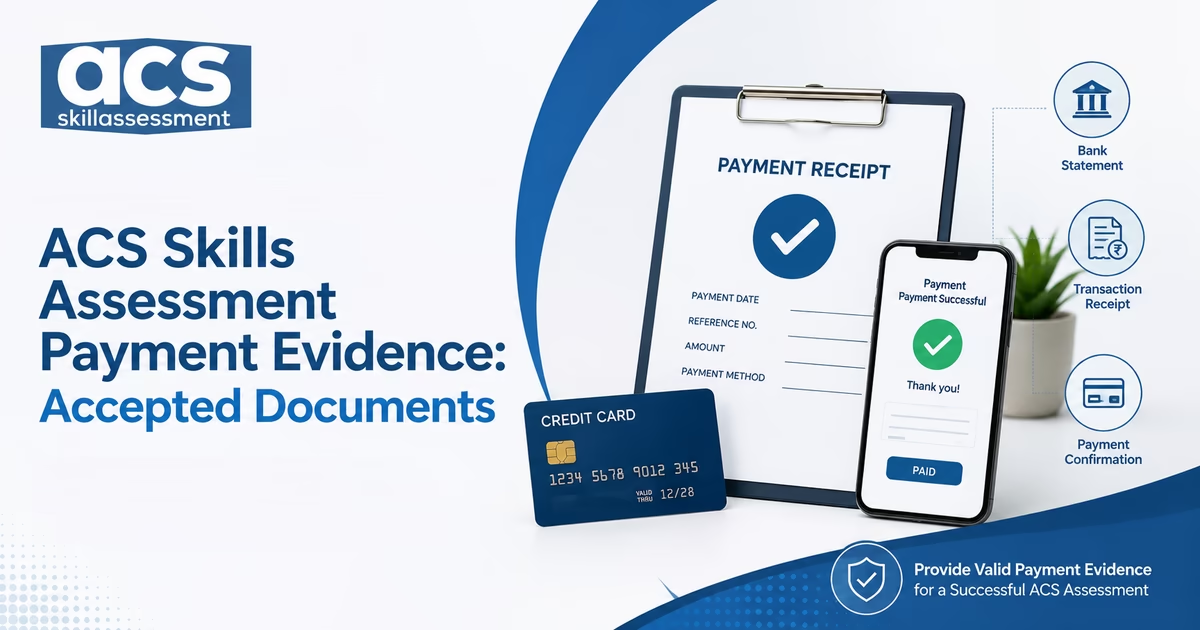
ACS recognises four categories of ACS skills assessment payment evidence: payslips, bank statements, government tax records, and employer salary letters. Superannuation and provident-fund statements sit alongside these as useful independent corroboration. The combination matters more than any single item, so treat this section as a parts list, not a menu you pick one from.
Payslips: the seven fields ACS actually checks
Most competitor checklists say a payslip needs your name and your employer's name. The ACS InfoHub payment evidence page lists seven required fields, and a payslip missing any of them can be rejected even when the names and salary are correct:
Employer name, address, and logo
Payment period start and end dates
Salary or wages amount
Tax information
Your full legal name
Job title
Work address
Job title and work address are the two that surprise people. A payslip that omits your role gives the assessor no link between the payment and the IT occupation you nominated.
For each past year of a role, supply one payslip from the start and one from the end of that twelve-month period. For your current role, supply your most recent payslips. Submitting every month contradicts ACS's own start-and-end framing and adds unnecessary bulk to your file.
Bank statements showing salary hitting your account
A bank statement earns its place because it is the classic non-employer document. Regular deposits matching your payslip amounts, ideally naming the employer in the transaction line, show that money arrived. On its own, though, a bank statement cannot prove who paid it or for what, which is why ACS never accepts it as standalone proof.
Tax records: group certificates, ATO income statements, and returns
Government tax records are the strongest corroboration you can file because a third party issued them. In Australia that means payment summaries (formerly group certificates), ATO income statements, or notices of assessment. Overseas equivalents work too, such as India's Form 16 or a US W-2. One hard limit: ACS will not accept a tax document you completed and lodged yourself with no official acknowledgement.
Employer salary letters and signed contracts
A salary letter on company letterhead stating your pay, and a signed employment contract, both help. Remember the source rule, though: these are employer-issued, so they can only ever be the employer half of your two-document pair. Pair them with something independent.
Which Documents Your ACS Skills Assessment Needs by Employment Type
This is where generic checklists stop being useful. The right package depends entirely on how you were engaged.
Full-time and part-time salaried employees
Payslips are your primary document; a bank statement or an ATO income statement supplies the independent second type. Part-time workers carry one extra burden: the payslip or reference must make clear you met ACS's minimum weekly-hours requirement, because anything below that threshold does not count toward your experience regardless of how clean the payment trail is.
IT contractors paid through an agency or umbrella company
Agency contractors face two separate requirements that applicants routinely collapse into one. For payment evidence, your agency or umbrella payslips are accepted. For experience verification, ACS requires the reference letter to come from the host company where you actually did the work, not the staffing agency that paid you. Corroborate the agency payslips with a placement contract or engagement letter that names the end client and confirms the role was IT-related. Miss that link and the assessor cannot connect your pay to skilled IT duties.
Self-employed IT consultants and sole traders
Personal payslips do not exist if you ran your own consultancy, and you should not try to manufacture them. ACS's freelance and contractor pathway asks for client statements on official letterhead plus either client invoices matched to your bank statements or official taxation records. For an Australian sole trader, that means ABN or ACN registration, Business Activity Statements (BAS), and personal tax returns: the three record types ACS cross-checks against business registration data to verify that the entity and the income were real. Where client references are genuinely unavailable, ACS allows a statutory declaration, but it must be backed by business registration, accountant statements, client letters, and payment evidence, not filed on its own.
Roles with overseas employers and non-AUD payslips
Foreign-currency payslips are usable, but only if they show the currency denomination clearly and give ACS a way to read the figure in Australian terms: either an AUD equivalent or an exchange-rate reference for the period. Any document not in English needs translation by a NAATI-accredited translator, with both the original and the translation submitted. Translations done outside Australia must sit on official letterhead with a stamp and the translator's name, signature, and contact number.
The Payment Evidence Decision Matrix
The table below maps each employment scenario to its primary document, the corroborating document ACS expects, and the single mistake that most often triggers an RFI. It is computed from the current ACS InfoHub payment and experience evidence guidelines, not from any one applicant's file.
Employment type | Required primary document | Required corroborating document | Most common rejection trigger |
|---|---|---|---|
Permanent salaried | Payslips (start and end of each year) | Bank statement or ATO income statement | Payslip missing job title or work address |
Part-time salaried | Payslips showing weekly hours | Bank statement or tax record | Weekly hours fall below ACS's minimum threshold |
Agency contractor | Agency or umbrella payslips | Placement contract naming end client; host-company reference | Reference sent from the agency instead of the host company |
Self-employed sole trader | Client invoices or BAS | Matched bank statements plus personal tax returns | Relying on a statutory declaration with no supporting records |
Overseas employer | Foreign payslips with currency shown | NAATI translation plus AUD or exchange-rate context | No AUD context, or an uncertified translation |
One variant deserves a separate note. For applicants from countries without an income-tax system, common for UAE, Qatar, and other Gulf-state roles, ACS accepts a government-issued work or residence permit showing employer name and employment dates as your secondary, non-employer document. That substitution is invisible on almost every competitor checklist, and it is often the only clean path for these applicants.
When Payslips Are Unavailable: What ACS Will Accept Instead
Payslips genuinely do not exist for some legitimate roles, and ACS knows it. A startup that paid by direct transfer with no formal slip, a consulting engagement billed by invoice, a role in a jurisdiction that never issued payslips: all are recoverable. Substitute the missing payslip with the strongest independent record available. Client invoices matched line-for-line to bank deposits carry real weight. So do official tax records, superannuation or provident-fund statements, and, for the no-income-tax jurisdictions above, a work or residence permit. The principle holds regardless of which document you swap in: you still need two types, and at least one from outside your employer.
Documents That Do Not Count as Standalone Payment Evidence
Some documents feel like proof and are not, at least not alone.
A single bank statement. It shows deposits but not their source or purpose.
An employer salary letter by itself. It is one employer-issued document, so the source rule still applies.
Cash-in-hand records. ACS does not accept cash payments as sufficient evidence.
A self-prepared tax document with no government acknowledgement.
Any one document type on its own, however detailed.
Every item on that list fails either the two-types test or the independent-source test. Adding a document from a different category and a different issuer fixes both gaps at once.
A Pre-Submission Check for Your Payment Evidence Package
Before you lodge, run each employment period past four questions:
1. Do I have at least two different types of payment evidence for this role?
2. Does at least one come from a non-employer source?
3. Do my payslips carry all seven required fields, including job title and work address?
4. Is every non-English document translated by a NAATI-accredited translator, with the original attached?
Unpaid and volunteer IT roles deserve a separate flag. No payment occurred, so payment documents cannot evidence them, and ACS excludes unpaid internships and volunteer work from qualifying experience. Assess those periods honestly and leave them out of your paid-experience total rather than padding the file with documents that will not support the claim.
Four yes answers for every role remove the most common reason ACS pauses an assessment over payment evidence.
Frequently Asked Questions About ACS Payment Evidence
Does ACS accept bank statements as a substitute for payslips?
Yes, as one of your two document types, but never on its own. A bank statement is an ideal non-employer document to pair with payslips or a tax record. Filed alone, it fails the two-types rule.
What payment evidence do I need if I worked for an overseas employer?
Your foreign payslips must show the currency denomination and include an AUD equivalent or exchange-rate reference so ACS can read the figures. Any non-English document needs a NAATI-accredited translation submitted alongside the original. If your country has no income-tax system, a government-issued work or residence permit can serve as your secondary evidence.
Can I use tax returns alone as ACS payment evidence?
No. A tax return is strong corroboration, but ACS requires at least two types of evidence per role, so pair it with payslips, bank statements, or another independent record. A tax document you completed yourself with no official acknowledgement is not accepted.
How many months of payslips does ACS typically require for each role?
For each past year of a role, one payslip from the start and one from the end of that twelve-month period. For your current role, your most recent payslips. Every month is not required, despite what some checklists claim.
What if my payslips are not in English: do I need certified translations?
Yes. Any document not in English must be translated by a NAATI-accredited translator, and you submit both the original and the translation. Translations prepared outside Australia must be on official letterhead with a stamp and the translator's name, signature, and contact number.
Do I need payment evidence for unpaid or volunteer IT roles?
No, because unpaid and volunteer roles cannot be evidenced with payment documents, and ACS does not count them as paid skilled employment. These periods are assessed under separate criteria and generally will not contribute to your required experience.
What payment documents work for self-employed IT contractors in Australia?
ABN or ACN registration, Business Activity Statements, and personal tax returns, ideally supported by client invoices matched to bank deposits. Personal payslips do not apply. Where client references are unavailable, a statutory declaration backed by those business records is the accepted route.
Once your ACS skills assessment payment evidence is watertight for every role, confirm the rest of your submission against the full ACS Skills Assessment Document Checklist before you apply, so a single missing category does not undo an otherwise complete file.